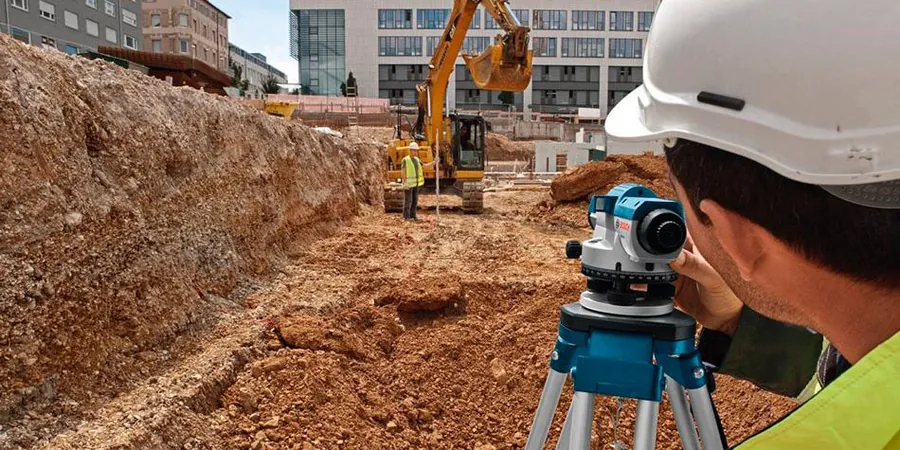
When we pull up to a site in San Bernardino with the drill rig and a set of thin-walled Shelby tubes, the first thing we look at is the alluvial fan deposits that dominate the valley floor. These soils often have a loose, honeycomb structure that looks stable when dry but can collapse suddenly under load once saturated. The evaluation starts with undisturbed sampling at multiple depths to capture the natural void ratio, then we run double-oedometer collapse tests in the lab. For projects near the Cajon Pass or along the I-215 corridor, we pair this with a compression test on undisturbed specimens to check unconfined strength, and we often recommend infiltration testing to estimate how fast water can reach the metastable zone.
In San Bernardino's alluvial fans, a dry soil can hold a building safely — until the first heavy rain triggers collapse.
Approach and scope
We follow ASTM D5333-03 as the primary standard for quantifying collapse potential, which is especially relevant in San Bernardino because of the deep alluvial sequences that can exceed 50 feet in parts of the city. The procedure involves consolidating a sample at natural moisture content, then flooding it under a constant vertical stress and measuring the sudden settlement. Our laboratory is ISO 17025 accredited, and the equipment includes fixed-ring oedometers with digital data loggers. Typical parameters we record include the collapse index (Ic), collapse strain, and the wetting-induced settlement at different stress levels. In deeper profiles, we integrate SPT results to correlate blow counts with collapse thresholds, and when the site has cemented layers we use direct shear testing on recompacted samples to assess post-collapse residual strength.
Technical reference image — San Bernardino
Local ground factors
The most common mistake we see from contractors in San Bernardino is assuming that because a soil is dense and hard when dry, it will stay that way after a wet season. That's false. The alluvial fans here have zones of loose, metastable fabric that can settle 6 to 12 inches under foundation loads after irrigation or a storm. If the collapsible soil evaluation is skipped, or if sampling is done without preserving in-situ moisture, the collapse potential goes completely undetected. We've seen slab-on-grade floors crack, retaining walls tilt, and utility lines rupture because of delayed hydro-collapse that nobody planned for.
Two identical undisturbed specimens are loaded in separate oedometers — one at natural moisture, the other flooded — to measure collapse strain directly. Results are reported as collapse index per ASTM D5333, with recommendations for foundation depth or soil improvement.
02
Field Infiltration & In-Situ Density Survey
We perform double-ring infiltrometer tests at planned building footprints to assess water entry rates, combined with sand-cone or nuclear density tests to verify in-situ dry density. This helps identify zones where the soil is loose enough to collapse upon wetting.
What is collapsible soil and why is it a problem in San Bernardino?
Collapsible soil has a loose, honeycomb structure that supports load when dry but undergoes sudden settlement when wetted. In San Bernardino, the alluvial fan deposits from the San Gabriel and San Bernardino Mountains often have this metastable fabric, especially in older terraces and dry washes.
How much does a collapsible soil evaluation typically cost in San Bernardino?
For a standard residential lot, expect between US$840 and US$2,520 depending on the number of test pits, undisturbed samples, and lab collapse tests. Larger commercial sites with deeper boring requirements fall at the higher end of that range.
Which ASTM standard governs the collapse test procedure?
ASTM D5333-03 is the primary standard for measuring collapse potential of soils. It specifies the double-oedometer method, sample preparation, and calculation of the collapse index. We also reference ASTM D2435 for consolidation properties and IBC Section 1803 for investigation requirements.
Can I build on collapsible soil without treating it first?
Technically yes, but it's risky. If the collapse potential is moderate (Ic > 1%), shallow foundations may experience differential settlement after the first wet season. Typical mitigation includes deep compaction, pre-wetting, or using a stiffened raft foundation. Our evaluation report will include specific recommendations based on your site's collapse index.
How deep should I sample to assess collapsible soil in San Bernardino?
We recommend sampling to at least the depth of influence of the foundation load, typically 10 to 20 feet for a one-story residence. In San Bernardino's alluvial fans, the metastable zone can extend deeper, and we often extend borings to 30 feet for commercial structures to capture the full collapse-prone profile.