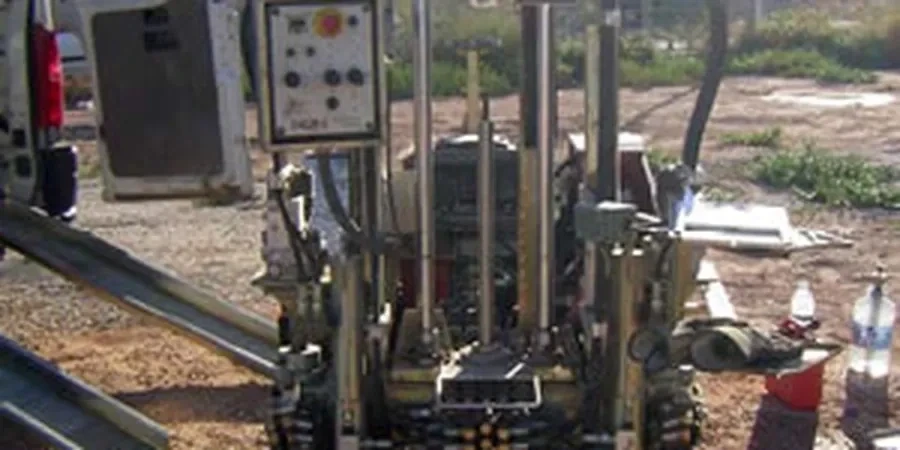
A common mistake contractors make in San Bernardino is assuming the alluvial fan deposits behave uniformly across the city. The soil profile changes drastically between the Lytle Creek wash, the Santa Ana River corridor, and the consolidated older fans near the hillsides. Without a continuous soil profile, you risk designing foundations on a sand lens that pinches out ten feet away. That is where the CPT (Cone Penetration Test) becomes essential — it provides a continuous, real-time log of cone resistance and sleeve friction, capturing every subtle layering that a standard boring could miss. Before finalizing foundation design, we recommend complementing this investigation with a study of expansive soils to identify near-surface clay lenses, and a direct shear test for shear strength parameters on specific strata.
Continuous CPT profiling in San Bernardino's alluvial fans captures every subtle layering that a standard boring could miss.
Approach and scope
San Bernardino's urban development accelerated after the Santa Fe Railroad arrived in the 1880s, with much of the early construction sitting directly on the active alluvial plains. Those early builders had no way to know that the subsurface contained buried channels, cobble beds, and variable silt layers from centuries of mountain runoff. Modern CPT equipment solves this by pushing a 1.5 cm² cone at 2 cm/s while sensors measure tip resistance, sleeve friction, and pore pressure every 5 mm. The key parameters we report include:
Cone resistance (qc) in MPa for bearing capacity estimates
Sleeve friction (fs) for soil classification per Robertson's 1990 chart
Pore pressure (u2) for drainage condition assessment
These parameters feed directly into IBC 2021 and ASCE 7-22 design criteria for San Bernardino projects.
Technical reference image — San Bernardino
Local ground factors
The difference between the older alluvial fans near the San Bernardino Foothills and the active floodplain along the Santa Ana River is night and day. In the foothills, you find dense, well-graded sands and gravels with cone resistances above 25 MPa. Along the river corridor, loose silty sands with qc values below 5 MPa dominate, and groundwater sits within 3 m of the surface. Designing a shallow foundation for a 3-story structure in the floodplain without a CPT risks differential settlement exceeding 25 mm. The continuous profile from the CPT identifies those loose layers and allows the geotechnical engineer to recommend deep foundations or soil improvement before construction begins.
5–40 MPa (typical range for San Bernardino alluvium)
Sleeve friction (fs)
0.05–0.35 MPa
Pore pressure ratio (Bq)
0.1–0.6 depending on drainage conditions
Soil Behavior Type (SBT)
Robertson 1990 chart — zones 2 to 7
Maximum penetration depth
30 m in favorable conditions; limited by cobble beds
Pushing speed
20 mm/s ± 5 mm/s per ASTM D5778-20
Related technical services
01
Standard Piezocone Penetration Test (CPTu)
Real-time measurement of tip resistance, sleeve friction, and pore pressure at 5 mm intervals. Includes soil behavior type classification, groundwater condition assessment, and bearing capacity estimates per ASCE 7-22. Suitable for most alluvial sites in San Bernardino.
02
Seismic Cone Penetration Test (SCPT)
Standard CPTu plus down-hole shear wave velocity (Vs) measurement using a triaxial geophone array. Provides Vs profiles for site class determination per ASCE 7-22 (Site Class C, D, or E) and liquefaction triggering analysis using the Robertson & Wride 1998 method.
Standards used
ASTM D5778-20: Standard Test Method for Electronic Friction Cone and Piezocone Penetration Testing of Soils, ASCE 7-22: Minimum Design Loads and Associated Criteria for Buildings and Other Structures, IBC 2021: International Building Code, Chapter 18 — Soils and Foundations, Robertson, P.K. (1990): Soil Classification Using the Cone Penetration Test
Quick answers
How much does a CPT test cost in San Bernardino?
A standard CPTu sounding in San Bernardino typically ranges between US$150 and US$260 per linear meter, depending on depth, access conditions, and whether seismic sensors are included. The final quote depends on mobilization distance and the number of soundings.
What soil types does the CPT detect in San Bernardino alluvium?
The CPT classifies soils into nine behavior types per Robertson's 1990 chart. In San Bernardino, we commonly encounter zones 2 (organic soils and clays) near the Santa Ana River, zones 5–6 (silty sands) in the transition fans, and zones 7–8 (sands to gravelly sands) in the older alluvial fans near the foothills. The continuous profile captures every layer boundary.
Can the CPT be performed in San Bernardino's cobble-rich soils?
Cobble beds and boulder layers are common in the active alluvial fans, particularly near Lytle Creek. Standard 15 cm² cone tips can refuse when encountering cobbles larger than 75 mm. In those cases, we use a larger 10-tonne cone or switch to a pre-drilling approach. We always assess surface conditions during mobilization to determine if a CPT is feasible.
How deep can the CPT penetrate in San Bernardino's alluvial basin?
Maximum penetration depth depends on soil density and the presence of cemented layers. In the younger alluvium of the Santa Ana River corridor, we typically reach 20–30 m. In the older consolidated fans near the hillsides, refusal occurs around 10–15 m due to dense gravels. The cone truck's 20-tonne reaction system handles most conditions found in the San Bernardino basin.