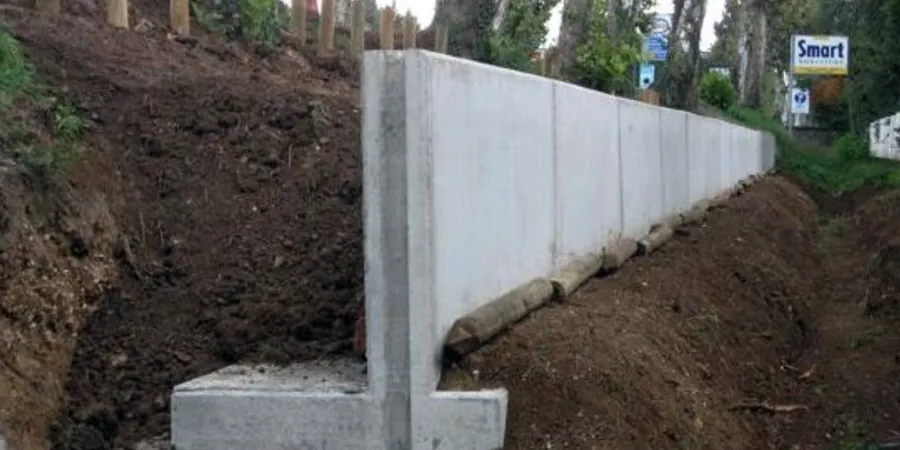
San Bernardino sits at an elevation of 1,053 ft in the foothills of the San Bernardino Mountains, which gives it a mix of alluvial fans and ancient landslide deposits. When we talk about retaining wall design here, the first thing that comes to mind is lateral earth pressure — because the soils change fast from sandy gravel to stiff clay within a single block. We have processed samples from the Verdemont area and the Santa Ana River corridor, and the variability is real. That is why we always run direct shear and consolidation tests on undisturbed samples to get the actual friction angle and cohesion. Without those numbers, the wall may end up undersized or overbuilt. In our experience, combining a site-specific soil mechanics study with the wall design saves time and avoids change orders later. The local geology demands it.
In San Bernardino, the soil can change from granular to plastic clay within 50 ft — lateral pressure estimates must be site-specific.
Approach and scope
The dominant soil units in San Bernardino are the Older Alluvium and the San Timoteo Formation, both of which can present high plasticity clay layers near the surface. For retaining wall design, the key parameter is the at-rest earth pressure coefficient (K0), which we determine through oedometer tests on intact samples. We have seen K0 values between 0.45 and 0.65 depending on the overconsolidation ratio. Groundwater is another issue — the water table can rise to within 6 ft after wet winters, so we include hydrostatic pressure in the design. We also run permeability tests in the field to estimate drainage requirements behind the wall. For walls taller than 8 ft, we recommend a phased excavation and shotcrete facing to avoid caving. Our approach follows IBC Section 1807 and ASCE 7 lateral pressure provisions.
Technical reference image — San Bernardino
Local ground factors
San Bernardino grew fast after World War II, with many hillside developments built without modern geotechnical oversight. The result is a legacy of undersized retaining walls that now show tilting or drainage failure. In the north end near the Cajon Pass, landslides have reactivated in old debris flow deposits. The biggest risk we see is assuming uniform soil conditions across a lot. Two test pits can reveal completely different clay layers just 30 ft apart. That is why we always recommend at least one deep boring per wall segment to check for weak zones. Ignoring the seismic component is another gamble — the San Andreas fault runs right through the city, and walls must resist both static and dynamic loads.
What soil parameters are most important for retaining wall design in San Bernardino?
The friction angle and cohesion from direct shear tests are the two most critical inputs. For clay layers, we also need the overconsolidation ratio from consolidation tests to estimate K0 correctly. In San Bernardino, ignoring the plasticity of the San Timoteo clays can lead to underestimated lateral pressures.
How much does a geotechnical investigation for a retaining wall typically cost?
A standard investigation including one boring, soil classification, and two direct shear tests runs between US$1,120 and US$3,840 depending on depth and number of samples. The range reflects the variability of San Bernardino soils — deeper or more stratified sites require additional testing.
Do I need a seismic analysis for a retaining wall in San Bernardino?
Yes, because the city is in Seismic Design Category D per IBC. The wall must resist a horizontal acceleration of about 0.18g to 0.24g depending on site class. We run pseudostatic analysis using the Mononobe-Okabe method with site-specific phi values. A wall without seismic check may fail during a moderate earthquake.