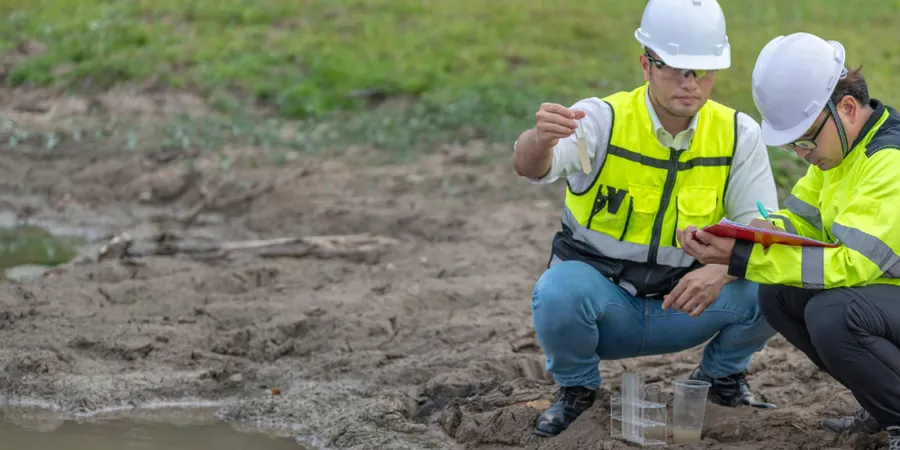
San Bernardino sits at 1,050 ft elevation where the San Andreas fault zone meets weathered granite and alluvial fans from the San Bernardino Mountains. These residual soils show high variability in thickness and plasticity within short distances, making site-specific characterization essential. Our team applies ASTM D2487 for classification and ASTM D1586 for SPT corrections to map the soil profile reliably. Before foundation design we often pair this with a corte directo test to measure shear strength parameters under drained conditions, and we cross-reference results with asentamientos analysis to predict total and differential settlements across the property.
Residual soil thickness in San Bernardino varies from 5 ft to over 30 ft within a single block, making blanket design assumptions inadequate.
Approach and scope
On a recent project near Hospitality Lane we encountered residual soil profiles with decomposed granite extending 18 ft before reaching competent bedrock. The matrix contained cobbles and clay seams that required careful handling during sampling. Our characterization protocol includes:
Continuous SPT sampling at 5-ft intervals per ASTM D1586
Water content and Atterberg limits on representative samples
In-situ density tests using the sand cone method
The clay fraction in these weathered materials often reaches 35-40% and exhibits moderate expansion potential under cyclic wet-dry cycles. We correlate these results with suelos-expansivos analysis to determine if special foundation measures are needed for residential or light commercial structures.
Technical reference image — San Bernardino
Local ground factors
Soils in the northern foothills near Devore tend to be coarser and better drained than the clay-rich residuals found around the central basin south of Interstate 10. This contrast creates two distinct failure scenarios: shallow slides on steep cuts in the coarser zones versus differential heave and settlement in the clay-bearing profiles. Both hazards become critical when residual soil characterization is incomplete, especially under the seismic demands of ASCE 7 Site Class D or E conditions common in the region.
Continuous SPT borings with split-spoon sampling at 5-ft intervals, logging of weathering profiles, and in-situ moisture and density measurements per ASTM D1586 and ASTM D2937.
02
Laboratory Classification and Index Testing
Full suite of index tests including Atterberg limits, grain size distribution (sieve and hydrometer), natural moisture content, and specific gravity on representative residual soil samples.
03
Geotechnical Profiling and Site Class Assessment
Integration of field and lab data to develop soil profiles, assign ASCE 7 Site Class (C, D, or E), and provide preliminary recommendations for shallow or deep foundation systems.
Standards used
ASTM D2487 – Standard Practice for Classification of Soils for Engineering Purposes, ASTM D1586 – Standard Test Method for Standard Penetration Test (SPT), ASTM D4318 – Standard Test Methods for Liquid Limit, Plastic Limit, and Plasticity Index of Soils, ASCE 7-16 – Minimum Design Loads and Associated Criteria for Buildings and Other Structures
Quick answers
What is residual soil characterization and why is it important in San Bernardino?
Residual soil characterization identifies the engineering properties of soil formed in place from weathering of parent rock. In San Bernardino, where weathered granite and alluvial materials dominate, it determines bearing capacity, settlement potential, and seismic site class for foundation design.
How deep do residual soils typically extend in San Bernardino?
Depths vary widely from about 5 ft near the mountain front to over 30 ft in the central basin. We use continuous SPT borings to map the transition from weathered soil to competent bedrock, typically completing characterization within two to four boreholes per site.
What laboratory tests are included in a standard residual soil characterization?
Standard tests include Atterberg limits (ASTM D4318), grain size analysis (ASTM D6913/D7928), natural moisture content, specific gravity, and unconfined compressive strength. For projects needing shear strength, we add direct shear or triaxial testing.
How does residual soil affect foundation design in San Bernardino?
Residual soils often present moderate to high plasticity and variable density, leading to differential settlement under load. Our characterization data helps engineers choose between spread footings with soil improvement or deep foundations like piles or drilled shafts.
What is the typical cost range for a residual soil characterization study in San Bernardino?
The cost ranges between US$810 and US$3,450 depending on the number of borings, depth of investigation, and laboratory tests required. A standard residential study with two borings and index tests falls near the lower end, while commercial projects with more depth and triaxial testing approach the upper range.