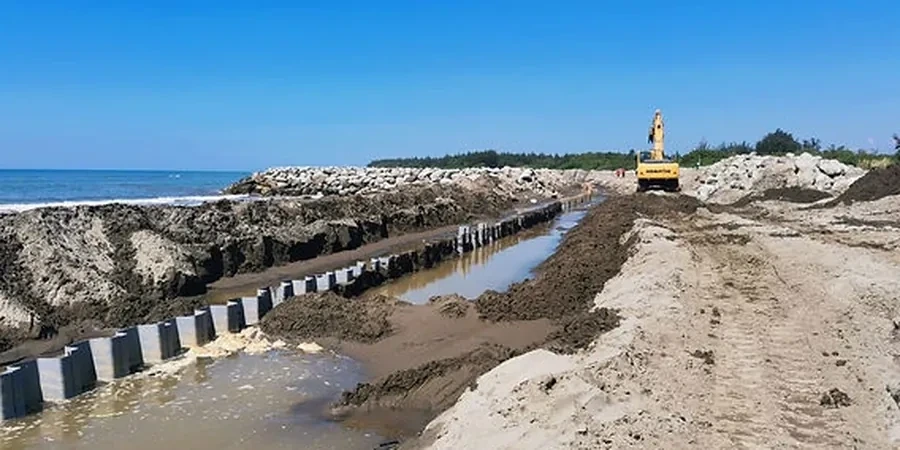
For retaining wall solutions in San Bernardino, sheet pile wall design must comply with ASCE 7-16 load combinations and IBC Chapter 18 for deep foundations. The city sits in a seismically active region crossed by the San Andreas fault zone, so dynamic earth pressures and liquefaction potential govern the design of interlocking steel sections. Our approach integrates site-specific soil stratigraphy with structural calibration to ensure the wall resists lateral earth loads, hydrostatic uplift, and seismic inertia simultaneously. Before finalizing the section modulus, we often correlate results with a compression test to validate undrained shear strength in cohesive layers.
Sheet pile wall embedment depth in alluvial sands must account for both passive resistance and seismic-induced pore pressure buildup.
Approach and scope
San Bernardino lies at an elevation of 1,050 ft along the alluvial fan of the Santa Ana River, where groundwater fluctuates seasonally and granular soils dominate the upper 15 m. Sheet pile wall design in this setting demands careful evaluation of passive resistance and seepage gradients. The process includes:
Determining embedment depth based on rotational stability and toe kick-out
Calculating anchor forces or strut loads for braced excavations
Selecting steel grade (ASTM A328 or A572) and section modulus
Assessing corrosion allowance in aggressive groundwater zones
We combine limit equilibrium analysis with finite element modeling, and for loose sand layers we cross-check against data from a liquefaction study to adjust the wall embedment.
Technical reference image — San Bernardino
Local ground factors
San Bernardino grew rapidly after the 1910s railroad boom, with many industrial yards and warehouses built on uncontrolled fill along the floodplain. Today, sheet pile wall design in the city must address the risk of buried debris, undocumented fills, and perched water tables that shift after heavy winter rains. A wall designed without verifying the actual soil profile can suffer excessive deflection or collapse during a seismic event. We require a subsurface investigation with SPT borings at 15 m centers before committing to a final section layout, and we review historical fill maps to avoid surprises during driving.
For unsupported excavations up to 6 m deep, we design cantilever walls that rely solely on passive earth resistance. The analysis includes rotation point determination, maximum bending moment, and deflection checks under static and seismic conditions.
02
Anchored Sheet Pile Wall Design
For retained heights exceeding 6 m, we design single or multi-tier anchored walls with grouted tiebacks or deadman anchors. Each anchor is tested to 133% of design load, and the wall section is optimized for both moment capacity and serviceability limits.
Standards used
ASCE 7-16 (Minimum Design Loads for Buildings and Other Structures), IBC 2021 Chapter 18 (Soils and Foundations), ASTM A328 / A572 (Steel Sheet Piling), FHWA-NHI-15-004 (Soil Nailing and Retaining Walls)
Quick answers
What geotechnical parameters are critical for sheet pile wall design in San Bernardino?
The three most critical parameters are the effective friction angle (phi') of the granular soils, the undrained shear strength (Su) in clay layers, and the groundwater depth. For seismic design, we also need the site class per ASCE 7 and the liquefaction potential of loose sands below the water table.
How deep should sheet piles be driven in San Bernardino alluvial soils?
Embedment depth typically ranges from 1.5 to 2.5 times the retained height, depending on soil density and water levels. For a 6 m wall in medium-dense sand with groundwater at 3 m, we usually require 9 to 12 m of pile penetration to ensure rotational stability and toe capacity.
What is the typical cost range for sheet pile wall design services in San Bernardino?
For a complete design package including soil investigation, structural calculations, and construction drawings, the cost ranges between US$1,620 and US$4,540. The final price depends on wall height, number of anchor tiers, and required corrosion protection.
Do you include corrosion protection recommendations in the design?
Yes, we specify corrosion allowances based on soil resistivity, pH, and chloride content measured on site. For San Bernardino's alluvial deposits with neutral to slightly acidic pH, a 1.5 mm corrosion allowance on each face is standard. In aggressive zones near old industrial fill, we increase it to 3.0 mm or recommend a protective coating.