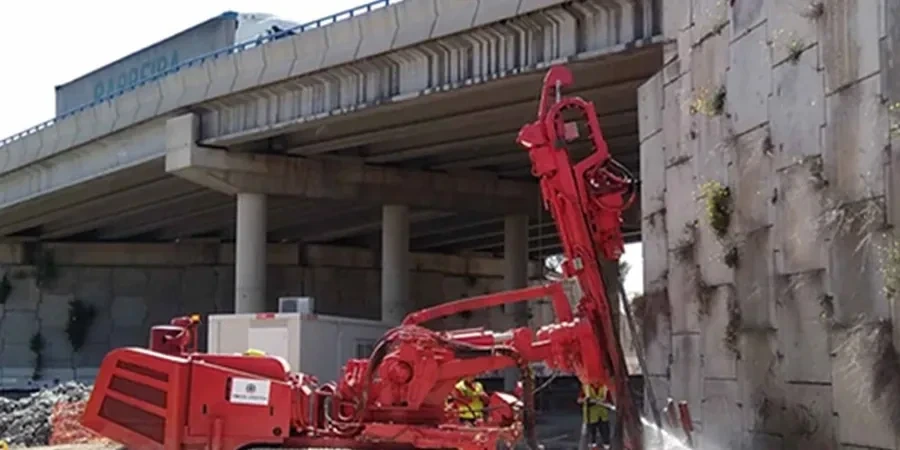
The rigs we deploy in San Bernardino are built for the alluvial fans and ancient river deposits beneath the city. High-pressure pumps, automated mixers and data-logging units travel directly to your site. Before any injection begins, we run a permeability test and cross-check the soil profile against existing borehole records. This ensures the grout mix matches the actual pore structure of the ground. When the target is a loose sand layer under a commercial slab, we combine our grouting design with a compression test on intact samples to verify the unconfined strength after treatment. Every job in San Bernardino follows a documented sequence: mix design approval, pressure limits, injection stage logging and post-treatment coring.
Grouting design in San Bernardino must account for fluctuating groundwater and alluvial layering to avoid uncontrolled fracturing and achieve uniform soil improvement.
Approach and scope
San Bernardino sits on a deep alluvial plain where groundwater fluctuates between 6 and 15 meters depending on the season. The soils are predominantly silty sands and gravelly sands with occasional clay lenses. This variability demands a grouting design that can adapt in real time. We use a stage-injection protocol with flow-rate caps to avoid hydrofracturing the finer layers. For projects near the Santa Ana River corridor, we factor in the higher permeability of the coarse channel deposits. Our methodology references the local water table records from the San Bernardino Valley Municipal Water District. In zones with perched water, we pair the grouting plan with a field permeability test to calibrate the injection pressure before mobilizing the rig.
Technical reference image — San Bernardino
Local ground factors
ASCE 7-22 requires consideration of liquefaction and differential settlement for sites in seismic zones. San Bernardino falls within Seismic Design Category D. Uncontrolled grouting can fracture fine-grained layers and create weak planes. The risk is real — a poorly designed injection program may push water into adjacent utility corridors or lift existing foundations. We follow ASTM D5092 for groundwater monitoring during injection and use pressure transducers to detect any abnormal rise. The biggest hazard in San Bernardino is the presence of undocumented fill and old stream channels. Without a proper grouting design, these zones will not densify uniformly.
Low-mobility grout injected under controlled pressure to densify loose sands and silts. Typical depth range 3 to 18 meters. Used beneath existing structures and new slabs.
02
Permeation Grouting Design
Low-viscosity cement or chemical grout to fill pore spaces in sands and gravels. Designed to match the soil permeability measured in situ. Common for excavation support and water cutoff walls.
03
Jet Grouting Design (Soilcrete)
High-velocity jet erosion and mixing of soil with grout to form columns or panels. Suitable for deep soft zones and groundwater control. Column diameters from 0.6 to 2.0 meters.
04
Fracture Grouting Design (Claquage)
Controlled hydraulic fracturing of stiff clays or siltstones to inject grout and improve strength. Selective application where conventional permeation is not feasible.
Standards used
ASCE 7-22 (Seismic Design Category D), ASTM D5092 – Standard Practice for Design and Installation of Groundwater Monitoring Wells, IBC 2021 – Chapter 18 (Soils and Foundations), FHWA Grouting Manual (FHWA-HIF-19-022)
Quick answers
How deep can grouting design treat soils in San Bernardino?
Depths vary by method. Compaction grouting reaches 18 meters, jet grouting up to 25 meters, and permeation grouting can exceed 30 meters in clean sands. The final depth depends on the target layer and access constraints.
What is the typical cost range for a grouting design project in San Bernardino?
The price range is US$1,240 to US$4,050 for the design and field supervision phase. This does not include grout materials or mobilization. The final cost depends on injection volume, number of stages and site access.
Do you use bentonite or cement grouts in San Bernardino projects?
Both. Cement-based grouts are standard for permeation and compaction work. Bentonite is added when lower permeability or better suspension is needed. The mix design is tailored to the soil gradation and target strength.
What post-treatment verification do you perform after grouting?
We core the treated zone at 7 and 28 days, run unconfined compression tests, and compare permeability before and after injection. For compaction grouting, we also measure density with a nuclear gauge. All results are documented in a final report.