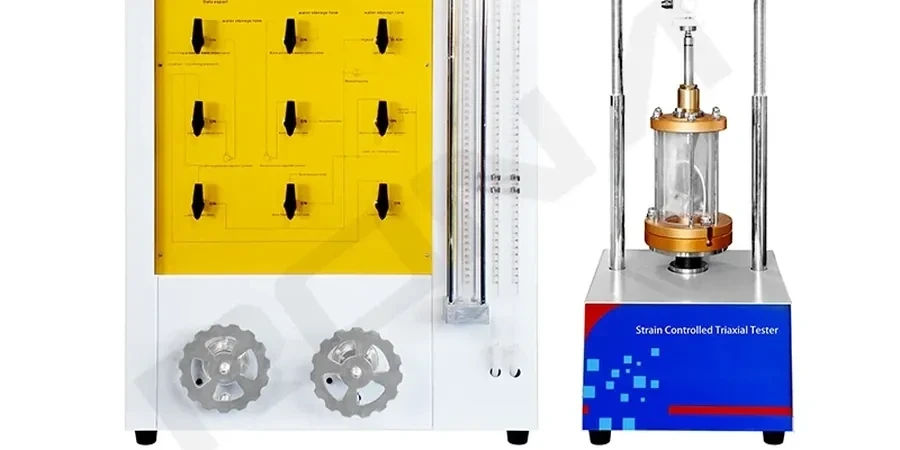
San Bernardino sits on a mix of alluvial fans and older terrace deposits, with groundwater depths varying from 5 to over 30 meters depending on the neighborhood. The sandy silts and clayey sands common in the area can behave very differently under load. That is why we run triaxial tests on undisturbed samples before any foundation design. This test gives you the actual cohesion and friction angle of the soil, not just a table value. For projects near the Santa Ana River or in the foothills, the data is even more critical because loose layers may exist. We combine triaxial results with a compression simple test on the same specimen to cross-check unconfined strength, and a corte directo when you need drained parameters for slow loading.
Triaxial testing in San Bernardino reveals that alluvial sands can lose 40% of shear strength when saturated — data that saves foundations from failure.
Approach and scope
Picture a 10-story apartment building planned on E Street, where the upper 6 meters are stiff silty clay over loose sand. The structural engineer needs reliable undrained shear strength for the mat foundation. We take thin-walled Shelby tubes at 1.5-meter intervals and run consolidated-undrained triaxial tests with pore pressure measurement. Our procedure follows ASTM D4767-11 for CU tests and ASTM D2850-15 for UU. For each depth we apply three confining pressures that match the expected overburden. The results give you cohesion, friction angle, and Skempton's B-value to verify saturation. For road embankments or cut slopes we also perform estabilidad taludes analysis using the same strength parameters.
Technical reference image — San Bernardino
Local ground factors
The most common mistake we see in San Bernardino is using SPT N-values alone to estimate shear strength for slope stability or retaining wall design. N-values are index numbers, not engineering parameters. A triaxial test directly measures how the soil fails under controlled stress — something a blow count cannot tell you. Without this data, a cut slope on the alluvial fan may appear stable during dry weather but fail during a wet winter. We have seen projects where the assumed friction angle was 8 degrees higher than the real value, leading to under-designed shoring. The cost of a few triaxial tests is negligible compared to a slope failure or a foundation repair.
This service complements our laboratory testing work for a complete project analysis.
Typical values
Parameter
Typical value
Confining pressure range
50 – 800 kPa
Specimen diameter
35 mm or 70 mm
Strain rate (CU test)
0.1 – 0.5 mm/min
Pore pressure transducer accuracy
±0.5% of full scale
Number of stages per test
3 (multi-stage available)
Related technical services
01
Unconsolidated-Undrained (UU) Triaxial Test
For rapid loading conditions like earthquake or traffic loads. We test three specimens at different confining pressures and report total stress parameters. Ideal for short-term stability checks on clay layers in San Bernardino.
02
Consolidated-Undrained (CU) Triaxial Test with Pore Pressure
Our most requested test for foundation design and slope analysis. We saturate the specimen, consolidate it under field stress, then shear it while measuring pore pressure. You get effective stress parameters (c', phi') and undrained strength (Su).
What is the difference between UU and CU triaxial tests?
The UU test (ASTM D2850) shears the specimen without allowing drainage during either consolidation or shearing. It gives total stress parameters for short-term conditions. The CU test (ASTM D4767) allows the specimen to consolidate under confining pressure before shearing, and measures pore pressure during shear. This gives effective stress parameters for long-term drained conditions.
How much does a triaxial test cost in San Bernardino?
A standard triaxial test in San Bernardino ranges between US$1.820 and US$2.790 per test, depending on the type (UU or CU), number of stages, and whether pore pressure measurement is included. Multi-stage or consolidated-drained tests cost more due to longer testing time. We provide a detailed quote after reviewing your project scope.
How long does a triaxial test take?
A UU test takes about 2 to 3 days including setup and shearing. A CU test with pore pressure measurement takes 5 to 7 days because the consolidation phase requires time, especially in clay. Drained tests can take 2 to 4 weeks due to very slow shearing rates. We prioritize projects with tight deadlines.