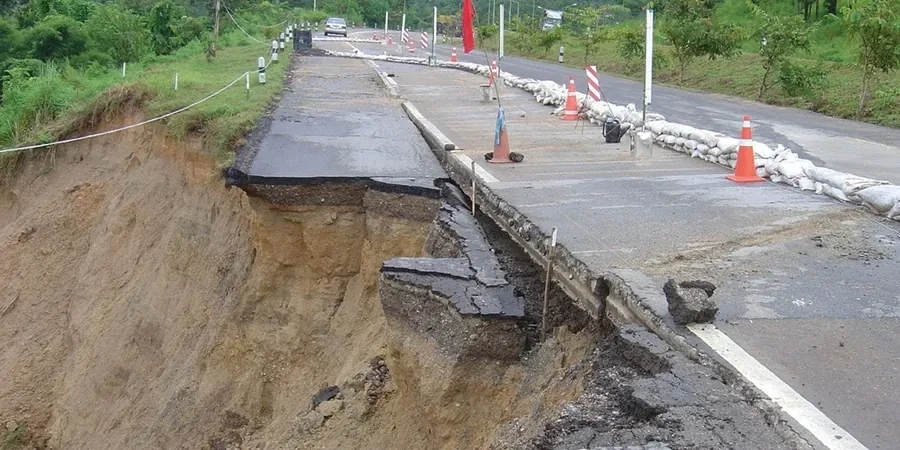
In San Bernardino, many projects face the challenge of building embankments on alluvial fans that transition abruptly into steeper hillside terrain. The contrast between loose granular deposits near the valley floor and denser colluvial soils upslope means a single design approach rarely works across the site. We start every road embankment design with a targeted subsurface investigation that captures both the shallow fill zone and the deeper bearing stratum. For sites where groundwater is shallow, we also incorporate a permeability field test to evaluate drainage before placing fill. This upfront work prevents differential settlement and slope failures that would otherwise appear months after compaction.
Compaction control during winter rains is critical in San Bernardino — wet fills left unsealed lose strength fast and trigger slope creep.
Approach and scope
San Bernardino sits at an elevation of roughly 1,050 feet, with annual rainfall averaging around 16 inches, mostly concentrated in winter months. These conditions create a distinct wet-dry cycle that affects compaction moisture control for road embankment design. The city's position near the San Andreas fault adds another layer: we must account for seismic loading on fill slopes following ASCE 7 criteria. A standard approach includes running compression simple tests on undisturbed samples to estimate undrained shear strength, then correlating those values with compaction curves from Modified Proctor (ASTM D1557). Our field team monitors lift thickness and moisture content using nuclear density gauges, verifying that each layer meets the specified 95% of maximum dry density before the next lift is placed.
Technical reference image — San Bernardino
Local ground factors
The most common failure in San Bernardino embankments happens when fill is placed during the dry summer months on a base that has not been properly scarified and recompacted. The interface between old ground and new fill becomes a slip plane once winter rains arrive. Our crews use a D8 dozer to rip the foundation layer to a depth of at least 12 inches, then recompact it at optimum moisture before the first fill lift goes down. We also install horizontal drains or a gravel blanket where the natural subgrade shows signs of seepage, because trapped water inside an embankment reduces effective stress and can trigger a rotational slide years after construction.
Boreholes, test pits, and SPT sampling to classify soils per ASTM D2487. We identify collapsible sands and expansive clays that affect embankment performance in San Bernardino's alluvial environment.
02
Compaction Testing & Moisture Control
Field density tests using nuclear gauge and sand cone methods, plus laboratory Proctor curves. We adjust moisture targets based on the seasonal climate to avoid over-drying or saturating lifts during placement.
03
Slope Stability Analysis & Seismic Design
Limit equilibrium and finite element analyses for static and pseudo-static conditions. We model the embankment geometry against San Bernardino's design earthquake (MCE = 0.75g) to verify factors of safety above 1.5.
Standards used
ASTM D698 / D1557 (Standard Proctor / Modified Proctor), AASHTO T-180 (Moisture-Density Relations), ASCE 7-16 (Minimum Design Loads for Buildings and Other Structures), FHWA-NHI-05-037 (Mechanics of Embankment Slopes)
Quick answers
What is the typical cost range for a road embankment design study in San Bernardino?
For a standard roadway fill project up to 20 feet high, the geotechnical investigation and design report typically ranges between US$1,260 and US$3,960. The final cost depends on the number of borings, laboratory testing volume, and whether seismic slope stability analysis is required.
How does the San Bernardino alluvial fan soil affect embankment compaction?
The granular soils common in the valley floor drain quickly, making it difficult to maintain optimum moisture during summer. We often need to add water during compaction and seal the finished lift within four hours to prevent rapid drying that creates weak, friable layers.
Do you include seismic slope stability in every road embankment design?
Yes, because San Bernardino lies in Seismic Design Category D per ASCE 7. We run pseudo-static and sometimes Newmark sliding block analyses for embankments over 15 feet high to ensure the fill mass remains stable during the design earthquake.