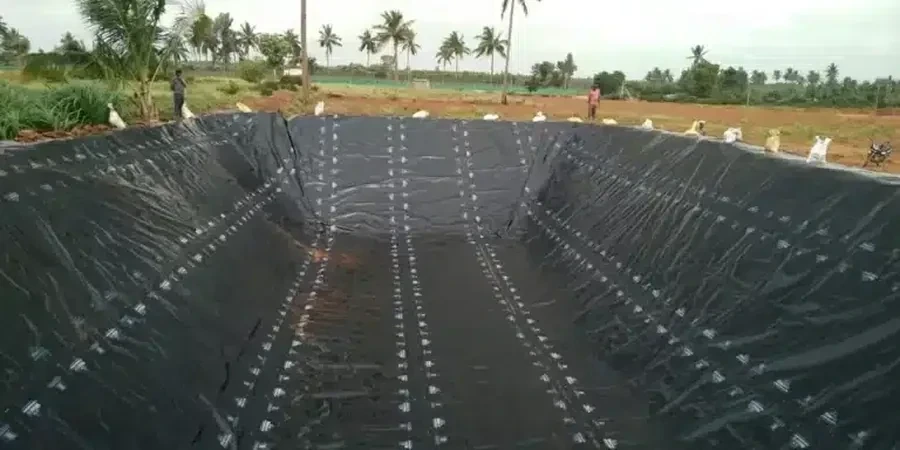
We unroll the geomembrane roll across the prepared subgrade using a dedicated deployment rig with a padded spreader bar. The crew works in two teams: one feeds the sheet from the roll, the other anchors the leading edge with sandbags. In San Bernardino, the alluvial fan deposits from the San Gabriel Mountains create a variable subgrade with cobbles and gravel lenses. Before any geomembrane placement, we grade the surface to remove protrusions larger than 1 inch and compact the subgrade to 95% Standard Proctor density. We then verify the prepared surface with a plate load test to confirm uniform bearing capacity across the pad area.
For San Bernardino projects, 60 mil HDPE with 3% carbon black is the baseline — anything thinner risks premature failure under UV and thermal stress.
Approach and scope
What we see most often in San Bernardino projects is the need for thicker geomembranes — 60 mil or 80 mil HDPE — because of the high UV exposure and temperature swings. The city sits at 1,050 feet elevation with over 300 sunny days per year, so UV stabilizers are non-negotiable. We specify carbon black content at 2% to 3% by weight per ASTM D1603. For seam integrity, we run destructive tests every 500 feet and nondestructive air pressure tests on all double-track fusion welds. The geomembrane specification must also account for thermal expansion: in summer, surface temperatures can hit 160°F, so we leave slack panels and sequence welding during cooler morning hours.
Technical reference image — San Bernardino
Local ground factors
San Bernardino grew rapidly after the railroad arrived in the 1880s, with much of the development on the alluvial fan of Warm Creek and Lytle Creek. These deposits are loose, coarse-grained, and highly permeable. The risk for geomembrane systems here is twofold: differential settlement from the variable alluvium can tear the liner, and high groundwater during wet years can create uplift pressures beneath the geomembrane. We always design a gas vent layer and a drainage geocomposite beneath the liner to manage these forces. For critical facilities like landfill cells, we also specify a leak location survey using the ASTM D7007 electrical method after placement.
We assess the subgrade bearing capacity, compaction, and surface smoothness before any geomembrane deployment. In San Bernardino's alluvial soils, we often recommend a 6-inch sand bedding layer to protect the liner from cobble punctures.
02
Seam Testing and Quality Control
Our team performs destructive peel and shear tests per ASTM D6392 and nondestructive air pressure tests on all field seams. We document every test location and provide a full QC report for the project record.
03
Leak Location Surveys (ASTM D7007)
After geomembrane placement, we conduct an electrical leak location survey to detect any holes or damage. This is especially important in San Bernardino's high-UV environment, where thermal stress can create micro-cracks during deployment.
Standards used
ASTM D6392 — Seam strength testing for geomembranes, ASTM D1603 — Carbon black content in polyolefin geomembranes, ASTM D4355 — UV resistance via xenon-arc exposure, ASTM D7007 — Electrical leak location survey, GRI GM13 — Standard specification for HDPE geomembranes
Quick answers
What thickness of geomembrane is recommended for landfill liners in San Bernardino?
For municipal solid waste landfill liners, we typically specify 60 mil (1.5 mm) HDPE as the minimum. For hazardous waste cells, 80 mil (2.0 mm) is standard. The high UV index and summer heat in San Bernardino make thicker liners with enhanced UV stabilizers a necessity.
How does the alluvial soil in San Bernardino affect geomembrane installation?
The alluvial fan deposits contain cobbles and gravel lenses that can puncture the geomembrane. We require a 6-inch sand bedding layer compacted to 95% Standard Proctor. A plate load test is done after grading to verify uniform bearing capacity before deployment.
What is the typical cost range for geomembrane specification services in San Bernardino?
Geomembrane specification services in San Bernardino typically range from US$560 to US$1,760 depending on the liner area, seam density, and testing scope. This includes subgrade inspection, material selection, seam testing, and final leak location survey. Volume discounts apply for larger projects.