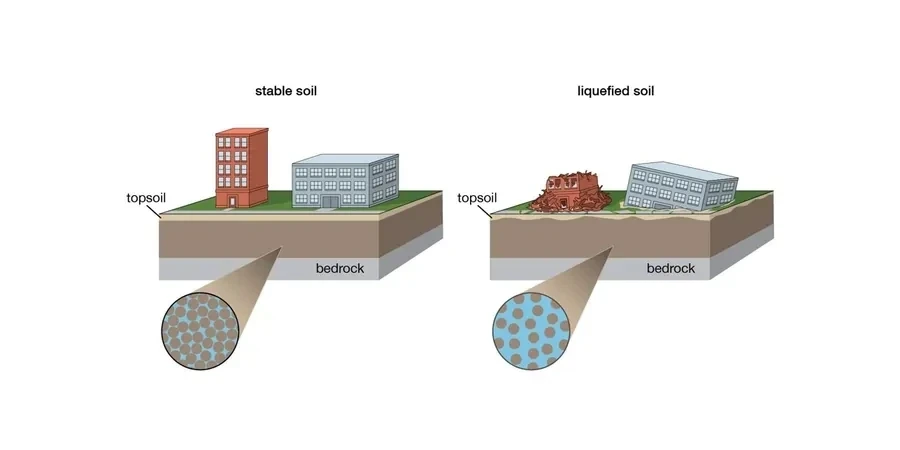
San Bernardino sits at the base of the San Bernardino Mountains, where alluvial fans and ancient river deposits create a complex subsurface. The region's seismic history, including the 1992 Landers and 1999 Hector Mine earthquakes, makes liquefaction a real concern for any development. Loose sands and silts beneath the city can lose strength during strong shaking. We perform detailed soil liquefaction analysis to identify those zones before you break ground. This is not a generic desk study. It combines field sampling with laboratory testing to classify each layer's susceptibility. For projects near the Santa Ana River or in older floodplains, the risk is higher. Complementing the study with a permeability field test helps us understand drainage conditions that affect pore pressure buildup. Our approach follows NCEER guidelines and the Youd-Idriss 2001 method.
Loose sands beneath San Bernardino can lose strength during a seismic event. We identify those zones before you build.
Approach and scope
San Bernardino's elevation ranges from 1,000 to over 5,000 feet within city limits, creating distinct soil zones. The downtown corridor sits on coarse alluvium, while areas like Verdemont and Devore have finer-grained deposits with higher liquefaction potential. Our soil liquefaction analysis evaluates each layer using four key criteria: grain size distribution, relative density through SPT N-values, groundwater depth, and cyclic stress ratio. Field crews perform standard penetration tests per ASTM D1586, and we run sieve analyses in our ISO 17025-accredited lab. When we encounter loose sands, we recommend additional sounding with the CPT for continuous profiles. The result is a factor-of-safety map for each boring location. We also assess post-liquefaction settlement and lateral spread potential. Every report includes site class per ASCE 7 and recommendations for mitigation if needed.
Technical reference image — San Bernardino
Local ground factors
Compare the alluvial terraces near Arrowhead Springs with the filled land along the 215 freeway corridor. The first has dense gravels with low liquefaction risk. The second contains loose sands and silts from historic grading, often saturated within 10 feet of the surface. A single earthquake event could trigger differential settlement in those zones, damaging foundations and underground utilities. Our soil liquefaction analysis quantifies that difference. We map the areas where cyclic softening is probable and where it is not. This lets you design foundations that match the actual ground behavior. Ignoring this step means assuming uniform risk across a city that is anything but uniform.
Measured during drilling, seasonal correction applied
Related technical services
01
Seismic Site Classification
Assign site class (A through F) per ASCE 7 using shear wave velocity or SPT data. We determine Vs30 from field measurements or correlations. This classification drives the seismic design parameters for your structure.
02
Liquefaction Triggering Evaluation
Calculate factor of safety for each soil layer using SPT-based CRR curves. We compare cyclic stress ratio from the design earthquake with cyclic resistance ratio from lab-calibrated relationships. Output includes liquefaction probability maps.
03
Post-Liquefaction Settlement Analysis
Estimate vertical and lateral displacements after triggering. We use volumetric strain methods for free-field settlement and Newmark sliding block analysis for lateral spread. Mitigation recommendations follow.
Standards used
ASCE 7-22 (Seismic site classification and liquefaction assessment), IBC 2021 (Chapter 18, liquefaction triggering evaluation), ASTM D1586-18 (Standard Penetration Test for SPT N-values), NCEER 1997 / Youd-Idriss 2001 (Liquefaction triggering curves)
Quick answers
When is soil liquefaction analysis required in San Bernardino?
The 2021 IBC requires liquefaction evaluation for Seismic Design Categories C, D, E, and F. San Bernardino falls under SDC D for most parcels. Any building with a risk category II or higher, or structures with shallow foundations near the water table, typically need this study. We recommend it for all commercial and multi-family projects.
What is the typical cost for a liquefaction study in San Bernardino?
A standard soil liquefaction analysis ranges between US$2,460 and US$3,910. This includes two to four borings to 50 feet depth, SPT testing, lab classification, and a report with factor-of-safety calculations. Larger sites or deeper investigations increase the cost. Contact us for a project-specific quote.
How long does the analysis take from field work to report?
Field drilling and sampling take 2 to 4 days depending on site access. Laboratory testing adds 5 to 7 business days. The engineering analysis and report require another 3 to 5 days. Total turnaround is usually 10 to 15 business days. We can expedite for urgent submittals.