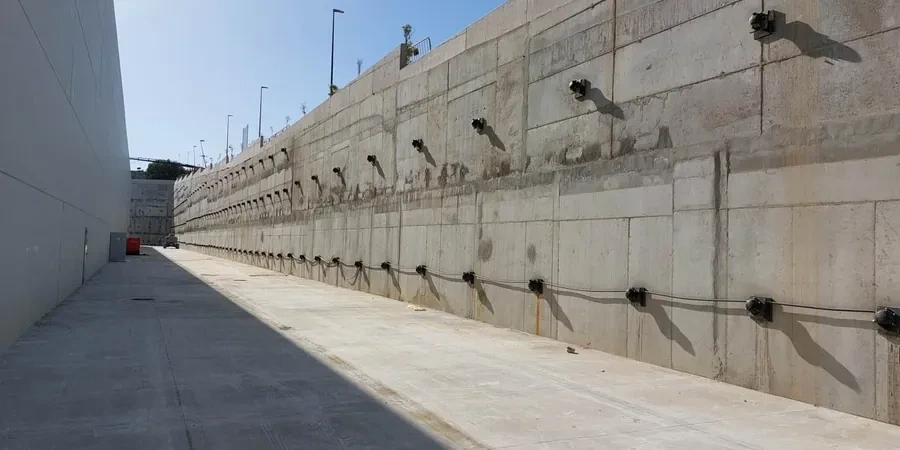
San Bernardino sits at the base of the San Bernardino Mountains, where alluvial fans and debris flows have deposited a mix of sands, gravels, and silty clays over millennia. The seasonal rainfall pattern — dry summers followed by intense winter storms — saturates these granular soils quickly, reducing effective stress and shear strength. For any retaining wall or shallow foundation in the city, we run the direct shear test to isolate the drained friction angle and cohesion of these heterogeneous deposits. This parameter set is critical before designing slopes or excavations, especially when combined with a stability analysis for slopes that considers the same soil layers under rapid drawdown conditions.
For San Bernardino's alluvial fans, the drained friction angle from direct shear is the single most reliable parameter for retaining wall and slope design.
Approach and scope
Our direct shear test in San Bernardino uses a Wykeham Farrance shear machine with a 60 mm square shear box, instrumented with a proving ring and two LVDTs for horizontal and vertical displacement. We apply normal stresses of 50, 100, and 200 kPa to simulate the range of overburden pressures typical for residential and light commercial projects in the city. Each specimen is sheared at a controlled rate of 0.5 mm/min under drained conditions, per ASTM D3080-18. The lab technician records peak and residual shear stress, then plots the Mohr-Coulomb envelope to extract cohesion and friction angle. We complement this data with a compression test on undisturbed samples for projects requiring unconfined strength of cohesive layers.
Local ground factors
In the Verdemont neighborhood, soils transition from well-graded sands to silty clays within 3 meters, while near the Santa Ana River corridor loose sandy deposits dominate. The direct shear test reveals that cohesion in these silty clays can drop by 40% when saturated, a risk that shallow foundations and slab-on-grade designs must account for. Ignoring this variation leads to differential settlement and slope instability along the foothills. Our testing isolates the critical failure envelope for each stratum, giving the structural engineer a defensible design parameter for San Bernardino's complex alluvial stratigraphy.
Standard test on saturated specimens at three normal stresses. Delivers effective cohesion and friction angle for long-term stability analysis.
02
Undrained Direct Shear
Fast shearing at 1.0 mm/min on as-moisture specimens. Simulates short-term loading during construction or rapid drawdown in retaining walls.
03
Multi-stage Direct Shear
One specimen sheared sequentially at three normal stresses. Saves sample material for projects with limited undisturbed tube recovery.
04
Residual Shear (Ring Shear)
Large-displacement test (up to 50 mm) to measure post-peak strength. Essential for reactivated landslides and existing slope failures.
Standards used
ASTM D3080-18 (Direct Shear Test for Soils), ASTM D2487-17 (Unified Soil Classification System), ASCE 7-22 (Minimum Design Loads and Associated Criteria)
Quick answers
How much does a direct shear test cost in San Bernardino?
The typical cost ranges from US$610 to US$750 per multi-stage test (three normal stresses). Volume discounts apply for 10+ specimens from the same project. Rush turnaround (48 hours) adds a 30% surcharge.
What is the difference between direct shear and triaxial for San Bernardino soils?
Direct shear is faster and cheaper, ideal for granular alluvial sands and silts common in the city. Triaxial is preferred for cohesive clays or when pore pressure measurement is required. For most residential projects here, direct shear provides sufficient accuracy.
How many direct shear tests do I need for a retaining wall design?
A minimum of three tests per soil unit is recommended — one per normal stress level. For walls over 4 m tall, we advise testing at two different depths to capture stratigraphic variability typical of San Bernardino alluvial fans.
Can direct shear be performed on compacted fill for a road embankment?
Yes. We compact remolded specimens at target density and moisture content per ASTM D698, then shear them. This gives the design engineer a reliable friction angle for the fill, which is essential for slope stability calculations along the I-215 corridor.