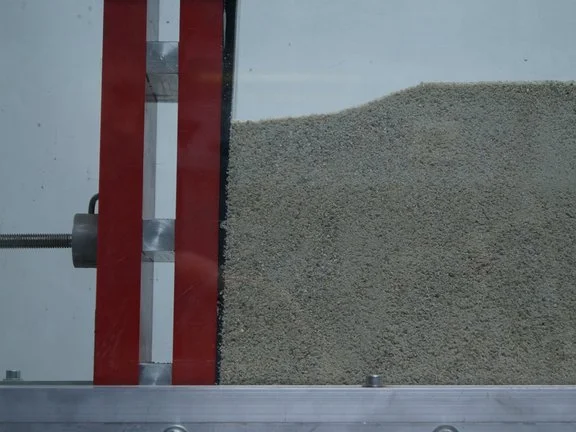
A few months back we consulted on a commercial plaza near the 215 freeway where the contractor kept hitting unexpected groundwater seeps during excavation. The site’s alluvial fan deposits — typical of San Bernardino — can hide dramatic changes in permeability within a few dozen feet. Running a falling head test on undisturbed samples from the deeper clay layers and a constant head test on the granular base material gave us the numbers needed to design a proper dewatering system. That kind of real-world scenario is exactly why we insist on laboratory permeability testing before any significant earthwork in San Bernardino. Without it you are guessing how water will move through the ground, and that rarely ends well.
In San Bernardino’s alluvial fans permeability can vary 100-fold within a single block — lab testing removes the guesswork.
Approach and scope
The contrast between the sandy terrace soils near the Santa Ana River channel and the denser alluvial clays closer to the San Bernardino Mountains is striking. In the riverwash zones constant head tests are straightforward because the material drains freely, while in the finer-grained areas we rely on falling head setups that measure very low coefficients of permeability. Before deciding which method fits a given project we often pair the lab work with a presurometer test to check in-situ deformation or a dilatometer test when we need lateral stress data. Both techniques complement the permeability results and give a fuller picture of how the ground will behave under load and water flow. Our lab runs each test per ASTM D2434 for constant head and ASTM D5084 for falling head, so the numbers are defensible in any review.
Technical reference image — San Bernardino
Local ground factors
San Bernardino sits in a semi-arid zone that gets sudden, intense winter storms — think atmospheric rivers that drop inches of rain in hours. When the ground is dry and cracked, water finds preferential paths that a standard lab test on a small sample might not capture. That is why we always correlate laboratory permeability results with field observations and, when budget allows, a borehole infiltration test to validate the lab numbers at a larger scale. Ignoring the difference between lab k-values and actual field behavior can lead to undersized drainage systems, slab heave in expansive clays, or worse, erosion along utility trenches.
Designed for sands and gravels common near the Santa Ana River. Uses a steady-flow setup to measure k under controlled gradients. Ideal for drainage layer design and filter specification.
02
Falling Head Test (Fine-Grained Soils)
For silts and clays typical of the older alluvial terraces in west San Bernardino. Measures slow seepage rates using a standpipe. Critical for seepage analysis below slab-on-grade foundations.
03
Consolidated Permeability (Triaxial)
Simulates field stress conditions by applying confining pressure during the test. Useful for deep excavations or when the soil will be loaded before water flow occurs.
Standards used
ASTM D2434-19 (Constant Head Permeability of Granular Soils), ASTM D5084-16a (Falling Head Permeability of Fine-Grained Soils), ASTM D854-14 (Specific Gravity of Soil Solids)
Quick answers
How does a falling head test differ from a constant head test?
Constant head is used for granular soils where water flows steadily under a fixed head difference; it gives a direct k-value. Falling head is for fine-grained soils where flow is slow and the head drops over time. Both follow ASTM procedures, and we choose the method based on the soil’s gradation and plasticity.
What is the typical cost range for laboratory permeability testing in San Bernardino?
For a standard falling or constant head test on a single specimen the range is between US$420 and US$660. The final price depends on the number of specimens, the saturation method required, and whether you need consolidated-permeability (triaxial) conditions.
Do you accept samples collected by our field crew, or must you drill them?
We can test samples you deliver as long as they are undisturbed tube samples or properly bagged bulk samples. For critical projects we prefer to coordinate the sampling ourselves to ensure the material reaches the lab without disturbance. Either way we log the sample condition on receipt.
How long does a permeability test take from sample receipt to report?
A falling head test on a clay sample typically takes 3 to 5 business days because of the saturation and equilibration time. Constant head tests on sands can be turned around in 2 to 3 days. We can rush critical projects with a 24-hour surcharge.