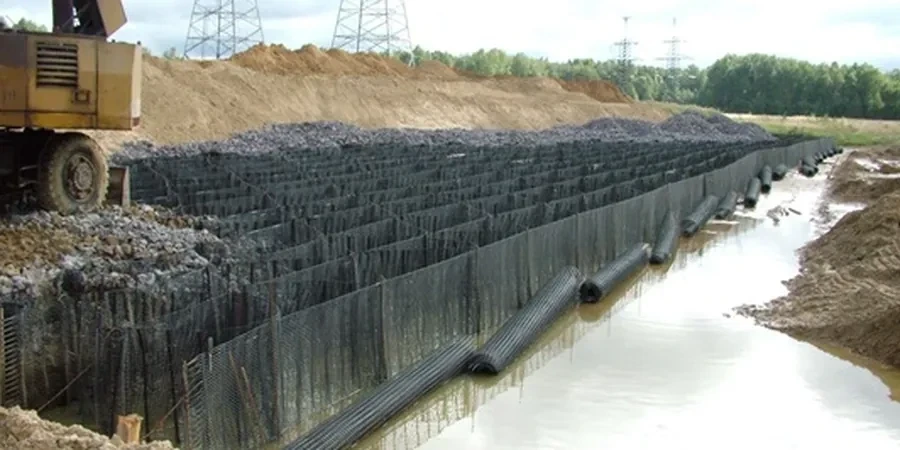
San Bernardino’s alluvial fans and ancient river terraces create a jarring contrast in subgrade conditions. Near the downtown corridor, you hit silty sands and gravels with decent bearing capacity, but push a few miles east toward the San Andreas fault zone and you’re dealing with collapsible soils and variable fill. That’s where geocell design becomes a practical solution. We’ve seen projects on the north side of the 210 freeway save weeks of excavation by placing a geocell confinement layer on weak subgrade instead of over-excavating and importing fill. Before specifying any design, we run a test pit investigation to map the soil profile and confirm whether the native material can actually anchor the geocell connections.
Geocell design in San Bernardino hinges on the fact that native silts and sands gain 40 percent more stiffness when confined in a 3D honeycomb.
Approach and scope
We design geocell systems per IBC Chapter 18 and ASTM D1586-18 for site classification. In San Bernardino, the N-values often drop below 10 blows per foot in the upper 6 feet, especially near the Santa Ana River wash. That low-density ground needs lateral confinement to spread loads and reduce differential settlement. Our approach integrates geocell design with the subgrade’s CBR value and the expected traffic loads. We use the FHWA’s cellular confinement guidelines to determine panel height, weld spacing, and infill material. In residential roads we specify 4-inch cell height with sand infill; for heavy truck access we go to 6-inch cells with crushed base. Each design links back to the site-specific soil classification from our lab tests.
Technical reference image — San Bernardino
Local ground factors
The alluvial soils along the 215 corridor often contain buried channels of loose sand and silt. When heavy rain saturates these layers, the ground loses its apparent cohesion and can flow laterally under load. Geocell design directly addresses this by trapping the soil particles inside the honeycomb and preventing particle migration. We also see risk from the region’s shallow groundwater table — in some areas near Lytle Creek the water sits at 8 feet. During seismic shaking, those saturated sands can liquefy. A properly anchored geocell mattress over a drainage layer reduces that risk by maintaining confinement even under dynamic loads.
We calculate the factor of safety for slopes between 2:1 and 1.5:1 using Bishop’s method, then design the geocell panel layout and anchor spacing to achieve FS ≥ 1.5 under saturated conditions.
02
Road subgrade reinforcement
For low-volume roads and access ramps on weak alluvial soils, we design geocell layers that reduce base thickness by up to 40 percent while maintaining design life. Infill specs are based on site CBR and traffic ESALs.
03
Retaining wall base confinement
When building MSE walls or gravity walls on San Bernardino’s silty sands, we use a geocell mattress under the wall footing to spread vertical load and limit differential settlement at the wall face.
04
Erosion control on channel banks
Along washes like Warm Creek and Devil Canyon Creek, we design geocell mats with veg-infill to resist velocities up to 12 ft/s. Anchor pins are calculated for the site’s scour depth and soil friction angle.
Standards used
ASTM D1586-18 (Standard Test Method for SPT), IBC Chapter 18 (Soils and Foundations, 2021 edition), FHWA-CFL/TD-08-003 (Guidelines for Geocell Confinement Systems), ASTM D2487-17 (Unified Soil Classification System)
Quick answers
How does geocell design differ from traditional geogrid reinforcement?
Geogrids work in tension to stabilize the soil mass along a plane, while geocells provide three-dimensional confinement. In San Bernardino’s loose sands, geocells increase the soil’s apparent cohesion by trapping particles, which is more effective than planar reinforcement when the subgrade has N-values below 8 blows/ft.
What is the typical cost range for a geocell design in San Bernardino?
For a standard residential or commercial project, the design and specification package runs between US$920 and US$2,200. That includes site-specific calculations, panel layout, anchor design, and infill specs. The final cost depends on slope height, area, and whether we need additional exploration like test pits.
Can geocell design be used on steep slopes in the San Bernardino Mountains?
Yes. For slopes steeper than 2:1, we design geocell systems with deeper anchors and closer weld spacing. We follow the FHWA guidelines for steep slopes and consider the site’s seismic acceleration (0.44g) to ensure the geocell stays intact during an earthquake. We also check for internal stability using the soil’s friction angle and the geocell’s seam strength.
How long does a geocell design take to complete?
Typically 5 to 10 business days after we receive the soil data. If we already have test pit logs or SPT results from the site, we can start calculations immediately. For new sites, we coordinate the field investigation first.
Do you include drainage design with the geocell system?
Yes. In San Bernardino’s alluvial soils, water buildup behind a geocell slope can cause uplift failure. We size a granular drainage layer beneath the geocell mattress and specify weep pipes or French drains at the base. The drainage design is always integrated with the geocell design to prevent hydrostatic pressure accumulation.