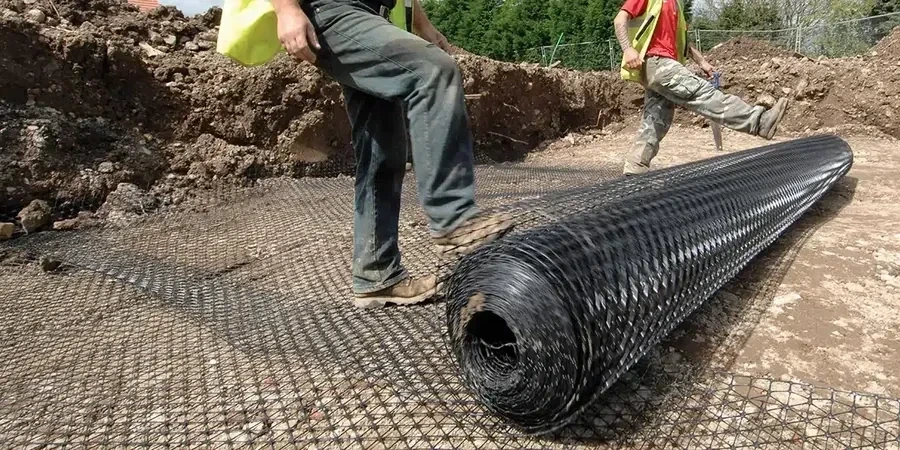
Rolling out a geogrid on a San Bernardino project starts with the right spec. Our team brings a portable tensile testing frame directly to Inland Empire sites, verifying ASTM D6637 grab strength on every roll before it hits the ground. We cross-check elongation and junction efficiency against the project's design load, not against a generic table. For the fractured bedrock and alluvial fans common in San Bernardino, the difference between a 400 lb/ft and an 800 lb/ft geogrid can mean the difference between a stable base and a $50,000 repair. That is why we pair each geogrid specification with a site-specific evaluation of pavement layers to confirm the reinforcement matches the subgrade modulus.
The correct geogrid spec balances tensile strength, aperture stability, and soil interaction — not just the strongest roll on the shelf.
Approach and scope
San Bernardino's semi-arid climate and seasonal flash floods create a unique challenge: expansive clays that shrink and swell under the same geogrid. A uniaxial geogrid designed for slope reinforcement will not control lateral spread in a clay subgrade. We specify biaxial or triaxial products based on the soil's plasticity index, measured per ASTM D4318. Our reports include aperture stability modulus and rib geometry, not just tensile strength. When the project involves a reinforced soil slope, we integrate the geogrid spec with a full stability analysis of the slope to ensure the reinforcement layer aligns with the critical failure surface.
Technical reference image — San Bernardino
Local ground factors
San Bernardino sits on the San Andreas Fault system, with peak ground accelerations up to 0.6g in a design earthquake. A geogrid specified without considering seismic pullout can fail during the next major event. We've seen retaining walls shift 4 inches because the geogrid embedment length was calculated for static loads only. Our specification includes seismic pullout capacity per NCMA guidelines, factoring the site's IBC Seismic Design Category E. That extra 3 feet of embedment can save a wall system during a magnitude 7.0 rupture.
Analysis of subgrade CBR, fill type, and design life to recommend the optimal geogrid grade. Includes interaction coefficient testing and pullout capacity calculations.
02
Construction Verification Testing
On-site verification of delivered geogrid rolls. Tensile testing per ASTM D6637, junction strength, and UV degradation check. Documentation for QA/QC submittals.
03
Reinforced Soil Wall & Slope Specs
Full specification package for MSE walls and reinforced slopes. Includes design review, seismic embedment, connection strength to facing panels, and drainage requirements.
What is the typical cost range for a geogrid specification package in San Bernardino?
A complete geogrid specification package — including design review, product selection, and verification testing — typically ranges from US$470 to US$1,410 depending on project complexity, number of geogrid layers, and required testing frequency. We provide a fixed-price quote after reviewing your plans.
Which ASTM standard applies to geogrid tensile testing?
ASTM D6637 is the primary standard for determining tensile properties of geogrids using the wide-width strip method. We also reference GRI-GG2 to evaluate junction efficiency, which is critical for geogrids used in San Bernardino's high-seismic zones.
Do I need a biaxial or uniaxial geogrid for a retaining wall in San Bernardino?
For a retaining wall taller than 6 feet, a uniaxial geogrid is typically required because it provides high tensile strength in the direction of the wall pullout. Biaxial geogrids are better suited for subgrade stabilization under pavements. The final decision depends on the wall design and soil conditions.
How does the San Bernardino seismic zone affect geogrid embedment length?
San Bernardino is in IBC Seismic Design Category E, requiring geogrid embedment lengths 20–30% longer than static designs. Our specification accounts for seismic pullout using NCMA guidelines to ensure the reinforcement does not pull out during a design earthquake.