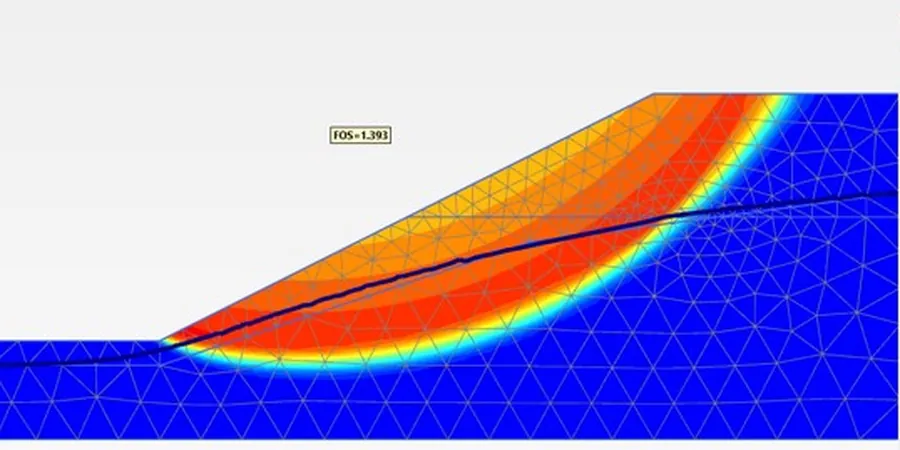
The soils in the Arrowhead Springs area differ sharply from those near the Santa Ana River floodplain. Up in the foothills, you get colluvium over weathered granite — loose, prone to movement after rain. Down by the river, it's sandy alluvium with a shallow water table. That contrast means a single slope failure analysis method doesn't work for every San Bernardino site. We tailor the approach based on geology, slope angle, and existing drainage. A cut slope in granite saprolite behaves completely differently from a fill slope on old river deposits. Before we run any model, we spend time understanding the local stratigraphy. That field judgment saves weeks of rework later. For deeper insight into soil behavior at shallow depths, we often combine this with a dilatometer test to measure lateral stress and stiffness in situ.
A two-foot tension crack at the top of a cut can turn into a full slope failure within one storm season if drainage is not addressed.
Approach and scope
Many times in San Bernardino we see failures that start as a small tension crack at the top of a cut, then propagate fast during a wet winter. The key is catching that crack early. Our slope failure analysis uses limit equilibrium and finite element methods, calibrated against local case histories from the 2005 and 2010 storm seasons. We pay close attention to the groundwater regime — perched water in colluvium is the main trigger here. Soil parameters come from direct shear and triaxial tests on undisturbed samples. We also run infiltration tests to rate the drainage layer performance. When the geology shows weak claystone layers, we recommend geocells as a surface stabilization system before the slope is fully regraded. That step prevents raveling during construction.
Technical reference image — San Bernardino
Local ground factors
The San Bernardino Valley sits in a high seismic zone with frequent Santa Ana wind events and occasional intense winter storms. That combination amplifies slope failure risk. A slope that passes static checks can still fail during a magnitude 6.5 earthquake if the soil loses cohesion. Our analysis accounts for both pseudostatic seismic coefficients and post-earthquake strength loss. We also evaluate debris flow runout paths for hillside lots below steep canyons. Ignoring the seismic trigger is the most common mistake we see in reports from other firms working here. We do not make that error.
Limit equilibrium (Bishop, Spencer) + FEM (PLAXIS 2D)
Minimum Factor of Safety
1.5 (static), 1.1 (pseudostatic per ASCE 7)
Soil Strength Model
Mohr-Coulomb or Hoek-Brown for rock slopes
Groundwater Condition
Steady-state seepage or transient rainfall infiltration
Seismic Load
PGA = 0.40g (San Bernardino, Site Class D)
Related technical services
01
Reconnaissance & Tension Crack Mapping
Field walkover to identify existing cracks, scarps, and seepage zones. We map the failure surface geometry and set up inclinometers when movement is active.
02
Limit Equilibrium & FEM Modeling
Two-dimensional and three-dimensional stability analysis using Spencer, Morgenstern-Price, and PLAXIS. We model rainfall infiltration and seismic loading per ASCE 7.
03
Remediation Design & Drainage Planning
Design of soil nails, shotcrete, buttress fills, or surface drainage systems. We provide construction-ready drawings and specifications for contractor bidding.
Standards used
ASCE 7-22 Minimum Design Loads (Chapter 12: Seismic, Chapter 3: Flood), ASTM D1586-18 Standard Test Method for SPT, FHWA-NHI-05-083 Slope Stability Manual
Quick answers
What is the first sign that a slope in San Bernardino is starting to fail?
Tension cracks at the top of the slope, usually 1-3 feet behind the crest. They often appear after the first heavy rain of the season. If you see a crack wider than half an inch, call us for an inspection.
How much does a slope failure analysis cost for a single-family lot in San Bernardino?
The typical cost ranges from US$860 to US$2,620 depending on slope height, access, and whether we need drilling or just surface mapping. We give a fixed price after a site visit.
Do you include seismic loading in the analysis?
Yes. San Bernardino is in a high seismic zone with PGA around 0.40g. We run pseudostatic and Newmark displacement analyses per ASCE 7 Chapter 12. That is standard in our reports.
What soil parameters do you need for the model?
Cohesion, friction angle, unit weight, and saturated permeability. We measure these from undisturbed samples using direct shear, triaxial, and falling head tests. If the slope has clay layers, we also run consolidation tests.
How long does the analysis take from field work to final report?
Typically 3 to 5 business days for a single lot. Larger subdivisions with multiple cross-sections take 1 to 2 weeks. We prioritize active failures where the house is at immediate risk.