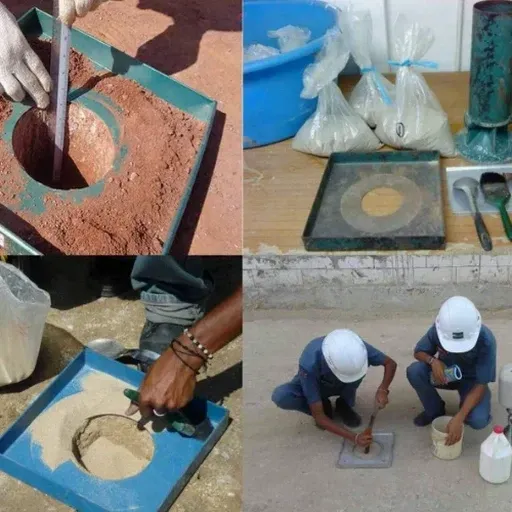
The alluvial fan deposits underlying much of San Bernardino create a highly variable compaction profile across short distances. We see this most clearly when testing structural fills for commercial pads near the I-215 corridor, where sandy gravels interbedded with silty layers require careful moisture-density monitoring. The sand cone method per ASTM D1556 gives us a direct volumetric measure of in-place density, which is essential when verifying that compacted lifts achieve the 95% relative compaction typically specified for building platforms in this region. For projects involving deep fills or retaining wall backfill, results from this test are often cross-referenced with asentamientos analysis to predict long-term settlement under design loads.
The sand cone method per ASTM D1556 provides a direct volumetric measure of in-place density, essential for verifying compaction in San Bernardino's variable alluvial fills.
Approach and scope
San Bernardino's post-war expansion into the alluvial terraces east of the city meant that many existing neighborhoods were built on uncontrolled fills from gravel mining operations. For today's renovations or new infill construction, the sand cone test provides a straightforward way to verify that replacement fills meet current IBC Chapter 18 requirements. Key aspects of the procedure include:
Excavation of a small test hole (typically 4-6 inches in diameter) down to the lift depth
Determination of wet density from the mass of excavated soil and the volume measured by sand replacement
Moisture content correction via oven-drying to obtain dry density
Comparison with maximum dry density from the project's Proctor curve (ASTM D698 or D1557)
When the backfill material contains oversize particles that compromise the sand cone's accuracy, we recommend combining this method with suelos-expansivos testing to evaluate swell potential in the finer fraction.
Technical reference image — San Bernardino
Local ground factors
The semi-arid climate in San Bernardino, with average annual rainfall under 16 inches, creates a moisture deficit that often leads to compaction near optimum water content but with a narrow working window. During the summer dry season, surface evaporation can dry out the lift before the roller finishes its pattern, producing a crust that masks low density below. The sand cone test captures that sub-surface condition directly, but the risk of false-positive results rises if the test is performed too close to the surface. Proper excavation depth — at least the full lift thickness — is non-negotiable for representative values.
ASTM D1556 field tests for structural fills, trench backfill, and pavement subgrade. Includes moisture content determination and comparison to project-specific Proctor curves.
02
Nuclear Gauge Correlation
Sand cone calibration checks for nuclear density gauges used in high-volume production testing. Ensures that rapid in-situ readings remain accurate throughout the project.
03
Moisture-Density Verification
Targeted testing for lifts near optimum moisture content, with same-day reporting. Suitable for quality assurance on DOT and municipal projects in the San Bernardino area.
Standards used
ASTM D1556-21 (Standard Test Method for Density and Unit Weight of Soil in Place by Sand-Cone Method), AASHTO T-191 (Density of Soil In-Place by the Sand-Cone Method), IBC 2021 Chapter 18 (Soils and Foundations)
Quick answers
How much does a field density test (sand cone) cost in San Bernardino?
The typical cost for a single sand cone density test in San Bernardino ranges between US$110 and US$170 per test point. This includes excavation, sand cone volume measurement, moisture content determination, and a report with density vs. Proctor comparison. Volume discounts apply for projects requiring 10 or more test points.
What compaction percentage is typically required for structural fills in San Bernardino?
Most building permits in San Bernardino require a minimum of 95% relative compaction per ASTM D698 (Standard Proctor) for structural fills, with 90% for non-structural areas. The specific requirement depends on the site's geotechnical report and the IBC 2021 Chapter 18 criteria adopted by the city.
Can the sand cone test be used on fills containing gravel or cobbles?
The sand cone method is suitable for soils with particles up to approximately 2 inches (50 mm) in diameter. For fills with larger cobbles or significant oversize content, the test hole may collapse or the sand volume measurement becomes unreliable. In those cases, we recommend the rubber balloon method (ASTM D2167) or a nuclear gauge with proper correlation.