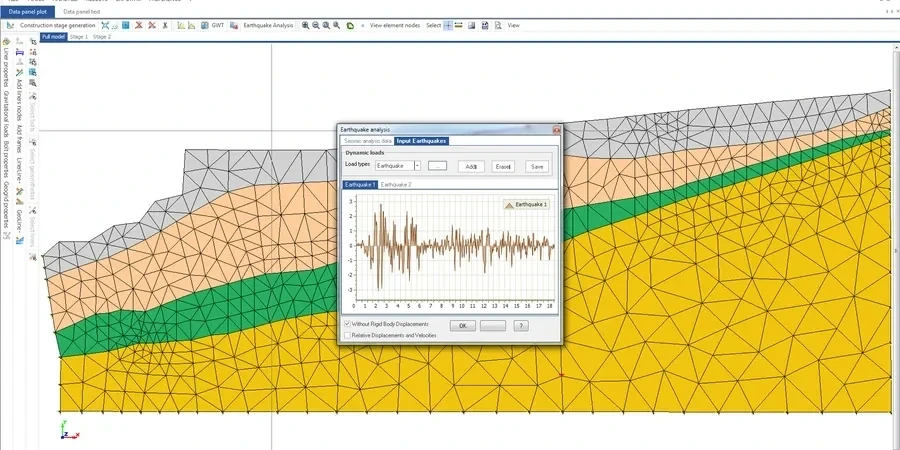
The contrast between the alluvial fans of the San Bernardino foothills and the older, stiffer soils near the downtown core creates a wide range of seismic site conditions. A site response analysis in San Bernardino must account for these differences, as the same earthquake motion can amplify or attenuate depending on the underlying soil column. For projects near the San Andreas fault zone, a detailed site response study is essential to capture the nonlinear behavior of granular soils under strong shaking. This is often paired with a study of liquefaction potential to evaluate cyclic softening in saturated layers, a common concern in the valley floor areas east of the I-215 corridor.
A site response analysis in San Bernardino must capture the nonlinear behavior of alluvial soils under strong shaking from the nearby San Andreas fault.
Approach and scope
San Bernardino's semi-arid climate and seasonal flash floods produce alluvial deposits with interbedded silts, sands, and gravels that exhibit significant stiffness variation with depth. The site response analysis methodology follows ASCE 7-22 guidelines for determining the Seismic Design Category (SDC) and site class (A through F). Field Vs30 measurements using MASW or ReMi provide the shear wave velocity profile required for input into equivalent-linear or fully nonlinear ground response programs. Key parameters include:
Input ground motions scaled to the MCER level per ASCE 7-22
Dynamic soil properties (G/Gmax and damping curves) from resonant column testing
This integrated approach ensures that design spectra reflect local basin effects rather than generic code values.
Technical reference image — San Bernardino
Local ground factors
In San Bernardino, many geotechnical failures stem from ignoring the seismic site effects unique to the alluvial fans. A structure designed with a generic stiff-soil profile may experience up to 60% higher spectral accelerations if the actual site class is D or E. The risk is compounded by soil liquefaction in loose sands and lateral spreading near the Santa Ana River channel. Without a proper site response analysis, shear strains can concentrate in soft layers leading to foundation differential settlement. This is especially critical for hospitals and emergency response facilities required to remain operational post-earthquake.
Non-invasive MASW and ReMi surveys to obtain shear wave velocity profiles to 30 m depth, classified per ASCE 7-22 site classes A through F. Includes dispersion curve inversion and uncertainty analysis.
02
Nonlinear Ground Response Analysis
Equivalent-linear (SHAKE) and fully nonlinear (DEEPSOIL, FLAC) 1D/2D analyses using input motions deaggregated for the San Bernardino region. Output includes acceleration response spectra, amplification factors, and strain time histories.
Standards used
ASCE 7-22 (Minimum Design Loads and Associated Criteria for Buildings and Other Structures), NEHRP Recommended Seismic Provisions (FEMA P-1050), ASTM D4428/D4428M (Crosshole Seismic Testing), ASTM D7400 (MASW for Shear Wave Velocity)
Quick answers
How does a site response analysis differ from a standard seismic hazard assessment?
A standard seismic hazard assessment provides peak ground acceleration (PGA) at the bedrock level from regional faults. A site response analysis propagates those motions through the local soil column to compute surface-level response spectra that account for soil amplification, resonance, and nonlinear effects. In San Bernardino alluvial deposits, this can amplify spectral accelerations by a factor of 2 to 3 at certain periods.
What is the typical cost range for a site response analysis in San Bernardino?
For a standard site response analysis including field Vs30 measurements, laboratory dynamic testing, and 1D equivalent-linear modeling, costs typically range between US$1,160 and US$3,650 depending on the number of input motions and complexity of the soil profile. Larger projects with multiple boring locations and 2D analyses fall at the higher end of this range.
Is site response analysis required for all new construction in San Bernardino?
The San Bernardino Municipal Code and California Building Code (CBC) reference ASCE 7-22 which mandates a site-specific ground motion hazard analysis for Seismic Design Categories D, E, and F. Most commercial and multi-family buildings in San Bernardino fall under SDC D due to proximity to the San Andreas fault. A site response analysis is the standard method to develop the design response spectrum.
How do you determine the input ground motions for the analysis?
Input motions are selected from the PEER NGA-West2 database using magnitude-distance deaggregation for the San Bernardino site. We typically use 11 to 22 spectrum-compatible motions scaled to the MCE_R level. For near-fault sites, directivity pulses are included in the selection. The motions are then applied as vertically propagating shear waves in the 1D soil column model.