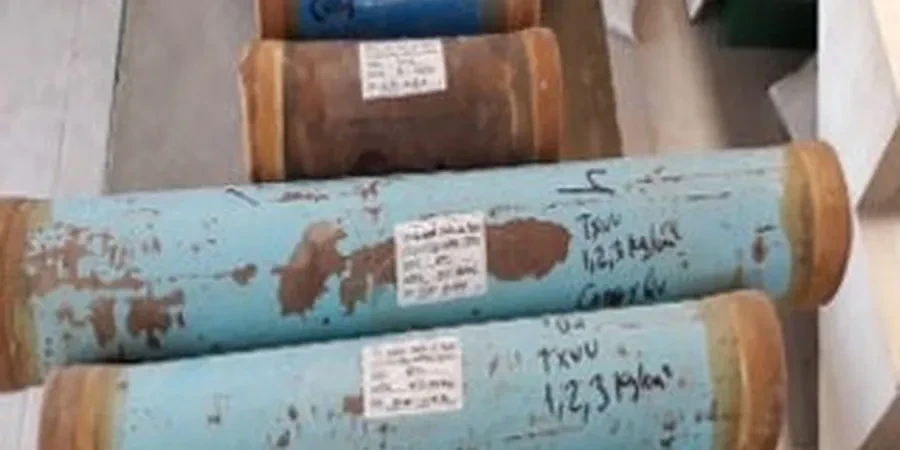
San Bernardino sits at the foot of the San Bernardino Mountains where the annual rainfall is less than 16 inches but the alluvial fan deposits from Lytle Creek and the Santa Ana River create a complex stratigraphy of interbedded sands, gravels, and silty clays. This dry environment, combined with a deep groundwater table often exceeding 50 feet, makes undisturbed sampling with Shelby tubes the preferred method for collecting intact soil specimens for laboratory testing. The thin-walled tube minimizes disturbance to the soil structure, which is critical for determining consolidation, shear strength, and permeability parameters in these heterogeneous alluvial soils. Before we extract a Shelby tube sample, we typically conduct a calicatas exploratorias to log the profile and identify the target horizon.
Undisturbed sampling with Shelby tubes preserves the in-situ soil structure, enabling accurate consolidation and strength testing for San Bernardino's alluvial deposits.
Approach and scope
Comparing soils near the downtown core with those along the I-215 corridor reveals significant differences in density and cementation. Downtown San Bernardino often has medium-dense silty sands with occasional gravel lenses, while the I-215 area near the Santa Ana River contains looser sandy deposits with higher moisture content. For undisturbed sampling in these conditions, we follow ASTM D1587 procedures: pushing the Shelby tube with a hydraulic system at a constant rate of 1 to 3 cm/s, never exceeding 5 cm/s to avoid plugging. The tube must be clean, dry, and lubricated before insertion. Once extracted, we immediately seal the ends with wax and plastic caps to preserve the natural moisture content. This method pairs naturally with ensayo SPT for correlating relative density and N-values, providing a complete picture of the soil behavior under load.
Technical reference image — San Bernardino
Local ground factors
The primary risk in San Bernardino is encountering gravelly or cemented layers that can damage the thin-walled Shelby tube or cause excessive disturbance. The alluvial fans contain cobbles and gravels from the mountain runoff, which may prevent tube advancement or collapse the borehole. If the tube meets refusal, we immediately stop and switch to a split-spoon sampler for the SPT. Another risk is sample disturbance from improper handling during extraction or transport. Our team seals each tube on-site, labels it with depth and orientation, and delivers it to the lab within 24 hours. We also monitor the borehole for caving, especially in the loose sands near the Santa Ana River, and use drilling mud when necessary to maintain stability.
3 in (76 mm) standard; 2 in (51 mm) for stiff clays
Maximum push length
30 in (762 mm) per tube
Penetration rate
1–3 cm/s, controlled hydraulic
Sample recovery ratio
>90% in cohesive soils; >70% in sands with liner
Storage transport
Sealed ends, vertical, temperature ≤ 40°C
Applicable soil types
Clay, silt, fine sand (non-gravelly)
Related technical services
01
Shelby Tube Sampling
Thin-walled tube sampling per ASTM D1587 for undisturbed specimens. We use 3-inch diameter tubes for most applications, with a hydraulic push system to ensure minimal disturbance.
02
Borehole Logging and SPT
Standard penetration testing (ASTM D1586) at 5-foot intervals in the same borehole. Provides N-values for correlation with undisturbed sample results.
03
Laboratory Testing
Consolidation, triaxial, and direct shear tests on Shelby tube samples. Our lab is ISO 17025 accredited, ensuring data reliability for foundation design.
04
Sample Preservation and Transport
Sealing, labeling, and temperature-controlled transport to preserve in-situ moisture and structure. We provide a chain-of-custody form with every sample.
Standards used
ASTM D1587-15 (Standard Practice for Thin-Walled Tube Sampling of Fine-Grained Soils), ASTM D4220/D4220M-14 (Standard Practices for Preserving and Transporting Soil Samples), ASTM D1586-18 (Standard Test Method for SPT and Split-Barrel Sampling), IBC 2021 (Chapter 18: Soils and Foundations)
Quick answers
What is the difference between undisturbed sampling and SPT sampling?
Undisturbed sampling uses a thin-walled Shelby tube to collect a relatively intact soil specimen, preserving the in-situ structure, density, and moisture content. SPT sampling uses a split-barrel spoon driven by a 140 lb hammer, which disturbs the soil but provides a penetration resistance (N-value) used for empirical correlations. Both are often performed in the same borehole: SPT for profiling and the Shelby tube for laboratory testing.
How much does undisturbed sampling (Shelby tube) cost in San Bernardino?
The cost for Shelby tube sampling in San Bernardino typically ranges between US$400 and US$1,130 per sample, depending on depth, ground conditions, and whether laboratory testing is included. Additional charges apply for mobilization, borehole drilling, and sample preservation. Contact us with your project details for a specific quote.
Can Shelby tube sampling be performed in gravelly soils?
Shelby tubes are not suitable for gravelly or very dense soils because the gravel can tear the thin-walled tube or cause refusal. In San Bernardino's alluvial deposits, we first log the borehole with an SPT. If gravels or cobbles are encountered, we switch to a split-spoon sampler or use a larger-diameter core barrel to obtain a representative sample.
What laboratory tests are typically performed on undisturbed samples?
Common tests include one-dimensional consolidation (ASTM D2435) for settlement analysis, unconfined compression (ASTM D2166) for undrained shear strength, and consolidated-undrained triaxial (ASTM D4767) for effective stress parameters. The test selection depends on the project requirements and soil type. All tests are performed in our accredited laboratory.