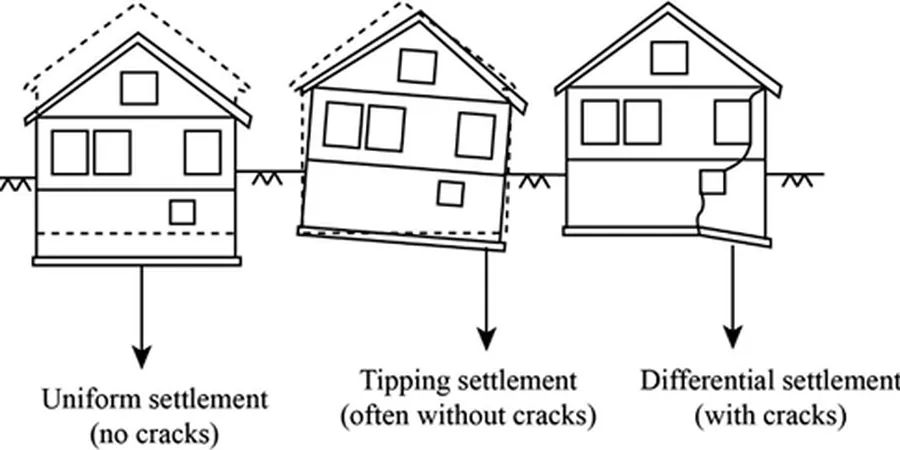
In San Bernardino, the contrast between the alluvial fans near the San Bernardino Mountains and the older terrace deposits along the Santa Ana River creates a tricky soil profile for foundations. A residential project near Kendall Drive might sit on dense sand and gravel, while a commercial site closer to the river encounters soft silt and clay layers at depth. That variability is exactly why we run a thorough differential settlement analysis before any slab or footing is poured. By comparing soil compressibility and layer thickness across the site, we identify zones where one column could settle twice as much as another. In our experience, pairing this with a consolidation test on undisturbed samples gives the most reliable numbers for the design team. The goal is simple: prevent cracked walls, tilted floors, and failed utility connections that plague structures built on uneven ground in San Bernardino.
Soil variability in San Bernardino can double settlement across a single site; contour mapping from multiple boreholes is the only reliable way to catch it.
Approach and scope
A common mistake we see from builders new to San Bernardino is assuming the soil is uniform across the entire lot. They take one boring near the street and call it done. That approach can miss a buried channel of soft clay or a lens of loose sand that triggers differential settlement after the building is framed. Our analysis method starts with at least three boreholes placed strategically across the footprint, plus a pavement evaluation if the site includes parking or access roads. We log the soil types per ASTM D2487, run consolidation tests on the most compressible layers, and calculate the expected settlement under the proposed loads using the Terzaghi one-dimensional method. The output is a settlement contour map that shows exactly where the risk is highest. For projects near the 215 freeway or the old railroad yards, we often find that deeper fills from the mid-1900s add another variable that requires careful handling.
Technical reference image — San Bernardino
Local ground factors
The combination of summer flash floods and extended dry periods in San Bernardino creates a desiccation cycle that heavily affects clay layers near the surface. When these clays dry out, they shrink and crack; when rewetted, they swell and soften. That cyclic behavior can cause progressive differential settlement over several years. On top of that, the region's seismic setting — San Bernardino sits near the San Andreas and San Jacinto faults — means that a moderate earthquake can densify loose sands unevenly under a foundation, triggering sudden differential movement. Our analysis accounts for both seasonal moisture changes and the potential for liquefaction-induced settlement in saturated sandy zones.
Settlement contour map + tabular predictions per column
Related technical services
01
Foundation Settlement Analysis
Detailed evaluation of expected settlement under shallow or deep foundations using consolidation parameters from undisturbed samples. Results include time-rate curves and contour maps for the entire building footprint.
02
Soil Variability Mapping
Subsurface profiling across the site with multiple boreholes and CPT soundings. We identify compressible layers, loose zones, and stiff pockets so the structural engineer can adjust the foundation design accordingly.
03
Seismic Settlement Assessment
Liquefaction-triggered settlement analysis per NCEER procedures, combined with post-earthquake volumetric strain estimates. Essential for San Bernardino projects in Zone 4 seismic areas.
What is differential settlement and why does it matter in San Bernardino?
Differential settlement is the uneven downward movement of different parts of a foundation. In San Bernardino, soil layers change rapidly due to the alluvial fan deposits and buried river channels, so one corner of a building can settle several inches while another barely moves. That difference cracks walls, breaks pipes, and warps floor slabs, making the structure unsafe or unserviceable.
How many boreholes are needed for a reliable differential settlement analysis?
For a typical residential lot (5,000–10,000 sq ft), we recommend at least three boreholes placed at opposite corners and the center. For commercial sites over 20,000 sq ft, five to six boreholes are standard. The goal is to capture the lateral variability of compressible layers across the entire footprint.
What is the typical cost range for a differential settlement study in San Bernardino?
A basic residential study with three boreholes and consolidation tests runs between US$680 and US$1,080. Larger commercial projects with five or six boreholes, CPT soundings, and full seismic settlement assessment typically cost US$1,480 to US$1,980. The final price depends on site access, depth of borings, and number of laboratory tests required.
Can differential settlement be fixed after the building is already constructed?
Yes, but it is more expensive and disruptive than preventing it beforehand. Common remedial methods include underpinning with helical piers or micropiles, slab jacking (polyurethane injection), and soil grouting to densify loose zones. However, a proper pre-construction analysis almost always identifies the risk early, allowing the foundation to be designed to handle the expected movements.
How long does the analysis take from field work to final report?
The field drilling and sampling typically take one to two days. Laboratory consolidation tests require about 10 to 14 days because each load increment must be held until primary consolidation is complete. The full report, including settlement contour maps and design recommendations, is delivered within three to four weeks after the field work finishes.