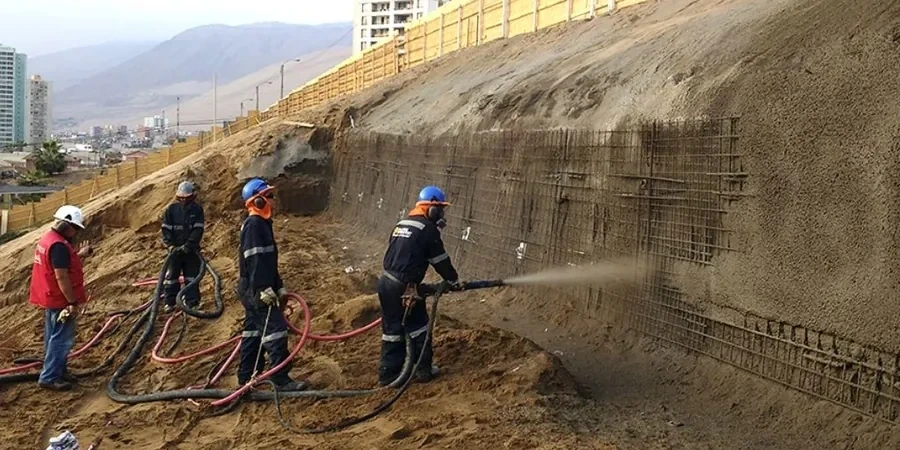
The field team mobilizes a track-mounted drill rig equipped with continuous sampling systems to extract undisturbed soil cores from the alluvial fans and weathered granitic slopes that define San Bernardino's terrain. These samples undergo direct shear testing under drained and undrained conditions to derive peak and residual strength parameters, which are then fed into limit equilibrium models using Bishop's simplified method and Spencer's method. For projects involving deep cuts or fill embankments, we complement the analysis with a permeability field test to assess groundwater seepage patterns, and when collapsible soils are suspected, we run a collapse potential evaluation on unsaturated soils to capture post-wetting strength loss that could trigger progressive failure.
In San Bernardino's hillside terrain, post-wetting strength loss from collapsible soils can reduce the factor of safety by over 30%.
Approach and scope
San Bernardino's semi-arid climate, with average annual rainfall under 16 inches, creates a scenario where surface infiltration is low but episodic storm events can saturate the upper soil profile rapidly, reducing effective stress along potential slip surfaces. The local geology — predominately older alluvium overlying granitic bedrock — produces a bimodal soil strength distribution: a dense, high-friction sand matrix underlain by fractured rock with variable joint orientation. To capture this heterogeneity, we perform limit equilibrium analyses with multiple slip surface search algorithms, including circular and non-circular failure mechanisms. We also integrate instrumentation monitoring to track pore pressure build-up during the rainy season, and for projects requiring precise shear strength characterization, we use the direct shear test on undisturbed specimens to obtain Mohr-Coulomb envelopes at representative confining stresses.
Technical reference image — San Bernardino
Local ground factors
San Bernardino sits at an elevation of 1,050 feet within the San Andreas fault zone, which last experienced a major rupture (Mw 7.9) in 1857. The combination of seismically induced acceleration and the presence of loose, unsaturated alluvial fans creates a liquefaction-triggered lateral spreading hazard that can undermine slope toes. A slope stability analysis that neglects the pseudo-static seismic component underestimates the driving forces by up to 30%, potentially leading to catastrophic failure during a design-level earthquake. We account for this by applying the NCEER (Youd-Idriss 2001) liquefaction triggering curves and the cyclic softening model for clayey soils under sustained shear.
Direct Shear (ASTM D3080), Triaxial CU (ASTM D4767)
Pore Pressure Model
Steady-state seepage (SEEP/W) or transient (HYDRUS)
Target Factor of Safety
1.5 (static), 1.1 (pseudo-static seismic)
Seismic Coefficient
SDS = 0.72g (IBC 2021, Site Class D)
Software Platform
Slide2 (Rocscience), SLOPE/W (GeoStudio)
Related technical services
01
Limit Equilibrium Modeling
We perform 2D limit equilibrium analyses using Bishop's simplified and Spencer's methods, with automatic slip surface search and multiple reinforcement scenarios. Output includes factor of safety contours, critical slip surface geometry, and sensitivity plots for material strength and water table depth.
02
Seismic Slope Stability Assessment
Pseudo-static and Newmark displacement analyses are conducted using site-specific acceleration parameters (SDS, SMS) derived from IBC 2021 seismic hazard maps. We compute yield acceleration and cumulative displacement for design-level earthquakes to evaluate post-seismic deformation tolerance.
What is the typical factor of safety required for slope stability in San Bernardino?
For static conditions, a minimum factor of safety of 1.5 is required per IBC 2021 for permanent slopes. For pseudo-static seismic analysis, we target a factor of safety of 1.1, though some jurisdictions may require a higher value depending on the consequence class of the structure.
How does the San Andreas fault proximity affect the slope stability analysis?
The San Andreas fault runs through the northern edge of San Bernardino, placing the city in Seismic Design Category D with SDS = 0.72g. Our analysis incorporates pseudo-static seismic coefficients and Newmark displacement calculations to account for co-seismic shear stress increase and post-seismic strength loss, especially in loose alluvial soils prone to liquefaction.
How much does a slope stability analysis cost in San Bernardino?
The cost for a slope stability analysis in San Bernardino typically ranges from US$1,230 to US$4,050, depending on the number of cross-sections analyzed, the complexity of the geology, and whether laboratory strength testing is required. A basic single-section analysis with existing geotechnical data falls at the lower end, while multi-section projects with seismic evaluation and sensitivity analysis approach the upper range.