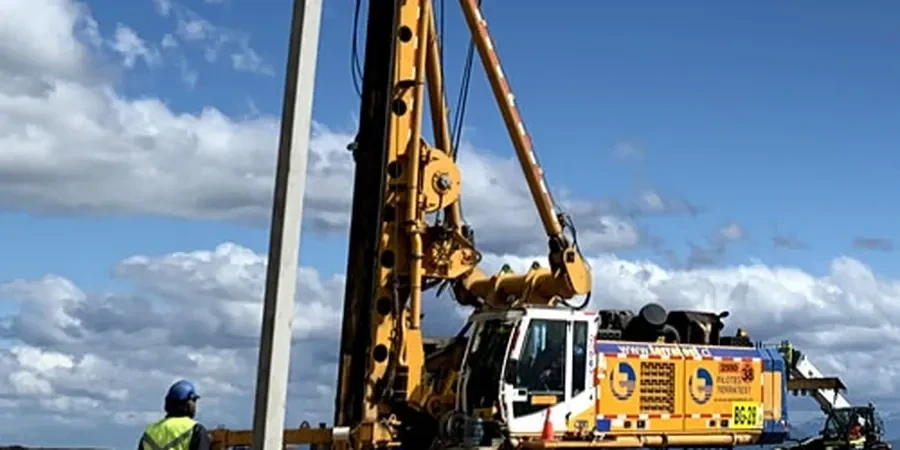
San Bernardino sits on deep alluvial deposits from the Santa Ana River watershed, with soil profiles that shift from dense sands and gravels near the canyon mouths to interbedded silts and clays toward the valley floor. Groundwater is typically 20 to 50 feet deep in most parts of the city, but rises seasonally near the river corridor. These conditions demand a thorough driven pile design approach, because end-bearing and skin friction vary dramatically across short distances. We combine SPT data with laboratory index testing to classify each stratum and assign shaft resistance values per FHWA method. A proper estudio de mecánica de suelos is the starting point for any deep foundation project in the Inland Empire.
In San Bernardino, the transition from alluvial sand to ancient lakebed clay can happen within 15 feet of depth — your pile capacity model must account for both.
Approach and scope
On a recent distribution center project near the 215 freeway, we designed driven piles to support column loads of 800 kips in a profile of medium-dense sand underlain by stiff clay. The key was correlating blow counts from ASTM D1586 tests with the local San Bernardino geology. We applied the Nordlund method for sand layers and the alpha method for cohesive zones, cross-checking capacities with wave equation analysis. For projects on the older alluvial fans east of the city, we often add ensayo CPT soundings to capture continuous cone resistance in gravelly sands. Pile driving logs are monitored in real time to verify refusal criteria match the design assumptions, and every job is referenced to IBC Chapter 18 requirements.
Technical reference image — San Bernardino
Local ground factors
The difference between a pile that reaches refusal at 40 feet near the San Bernardino foothills and one that keeps driving past 70 feet in the central valley floor is the presence of the old alluvial fan gravels versus younger floodplain deposits. Misidentifying the stratum boundary is the most common error in driven pile design here. If you assume end-bearing in a sand layer that pinches out laterally, the pile may not achieve the required nominal resistance. That is why we run suelos expansivos tests when clay layers are identified near the ground surface, and always verify shaft friction with at least one static load test on production piles.
Boreholes with SPT per ASTM D1586, plus classification tests (Atterberg limits, grain size, natural moisture) to characterize each soil layer for shaft and toe resistance calculations.
02
Pile Capacity Analysis and Wave Equation
Static capacity analysis using Nordlund and alpha methods, combined with GRLWEAP wave equation simulations to predict driving stresses and refusal criteria for concrete and steel piles.
03
Static and Dynamic Load Testing
Full-scale pile load tests (ASTM D3966) with PDA monitoring to validate design assumptions and adjust driving criteria during production, reducing foundation risk in variable ground.
Standards used
ASTM D1586-18 (Standard Penetration Test), IBC 2018 Chapter 18 (Soils and Foundations), FHWA NHI-16-009 (Design and Construction of Driven Pile Foundations), ASTM D3966-18 (Static Load Test for Deep Foundations)
Quick answers
What soil conditions make driven piles the right choice in San Bernardino?
Driven piles perform well in the dense sands and gravels found near the alluvial fans east of downtown, where end-bearing values are high. They also work in the interbedded clays of the valley floor when shaft friction is mobilized properly. The key is matching pile type to the dominant stratum.
How much does driven pile design typically cost in San Bernardino?
For a commercial or industrial project, the geotechnical investigation and design report for driven piles usually ranges between US$1,450 and US$3,850 depending on the number of borings, pile types considered, and load test requirements. Contact us for a project-specific quote.
What safety factor is required for driven pile foundations under IBC?
IBC 2018 requires a minimum factor of safety of 2.0 for deep foundations when using nominal resistance determined by static analysis or dynamic formulas. For structures in Seismic Design Category D or higher, we often apply 2.5 to account for the higher demand in San Bernardino.
Can driven piles be used near the Santa Ana River floodplain?
Yes, but the design must account for groundwater fluctuations and potential scour. In those zones we reduce shaft friction for the upper 10 to 15 feet and consider using steel H-piles with corrosion protection. A site-specific study is essential before production.