Geotechnical laboratory testing in San Bernardino provides the essential data required to understand soil and rock behavior, transforming field samples into reliable engineering parameters. This category encompasses a comprehensive suite of index, strength, and consolidation tests designed to evaluate subsurface materials for construction, infrastructure, and environmental projects. From characterizing residual soils derived from weathered granitic and metamorphic bedrock to measuring shear strength and compressibility, these analyses form the backbone of foundation design, slope stability assessment, and earthwork quality control. In a region shaped by complex geology and seismic activity, accurate laboratory data is not merely a regulatory checkbox—it is a critical safeguard against structural failure and costly post-construction remediation.
San Bernardino's geological setting presents unique challenges that make thorough laboratory investigation indispensable. The city sits at the intersection of the San Andreas and San Jacinto fault systems, while its varied terrain includes alluvial basins, ancient lakebed deposits, and hillside formations prone to shallow landslides. Much of the area is underlain by residual soils formed through in-situ weathering of the surrounding San Bernardino Mountains' granodiorite and gneiss, materials whose engineering properties can vary dramatically over short distances. These soils often exhibit metastable structures that may collapse upon wetting or lose strength when disturbed. Additionally, the presence of expansive clays in certain basin deposits requires careful identification through specialized testing to mitigate heave-related damage to pavements and shallow foundations.
Laboratory testing programs in San Bernardino must align with established standards, primarily those set by ASTM International and Caltrans. Key specifications include ASTM D422 for particle-size analysis, ASTM D4318 for Atterberg limits, ASTM D2166 for unconfined compression tests, and ASTM D3080 for direct shear tests. Consolidation properties are determined following ASTM D2435, while permeability testing adheres to ASTM D5084 for flexible-wall methods or D2434 for constant-head conditions. For projects involving state highway right-of-way or funding, Caltrans Standard Specifications and the California Test Methods (CTM) series often govern, particularly for laboratory CBR testing per CTM 216. These protocols ensure consistency, legal defensibility, and acceptance by reviewing agencies throughout the Inland Empire.
The range of projects requiring laboratory soils testing in San Bernardino is broad and continuously evolving. Municipal infrastructure upgrades, including road widening along the 210 and 215 corridors, demand resilient pavement subgrades validated through CBR and resilient modulus testing. Residential and commercial developments spreading into the foothills north of the 210 freeway rely heavily on residual soil characterization and triaxial shear data to design deep foundations and mitigate landslide risk. Public works projects such as flood control basins, groundwater recharge facilities, and the ongoing expansion of San Bernardino International Airport require permeability and consolidation testing to ensure long-term performance under saturated and cyclic loading conditions. Even smaller-scale retaining wall designs and pool excavations benefit from properly executed laboratory programs that reduce uncertainty in lateral earth pressure calculations.
A comprehensive program usually begins with index tests such as moisture content, Atterberg limits, and particle-size analysis to classify soils under the Unified Soil Classification System. This is followed by engineering property tests including unconfined compression, direct shear, triaxial, and consolidation tests. For pavement design, laboratory CBR tests are common, while permeability tests using falling or constant head methods address drainage and seepage concerns. The specific suite depends on the project's geotechnical scope and the materials encountered.
San Bernardino's residual soils, formed from weathered granitic and metamorphic rocks, often retain the fabric of the parent material but can be collapsible or dispersive. This necessitates specialized characterization beyond standard index tests, including double-consolidation testing for collapse potential and pinhole erosion tests for dispersivity. The region's alluvial and lacustrine deposits may contain expansive clays requiring swell-consolidation testing. Seismic considerations also drive the need for cyclic triaxial or resonant column tests to determine dynamic soil properties for liquefaction assessment.
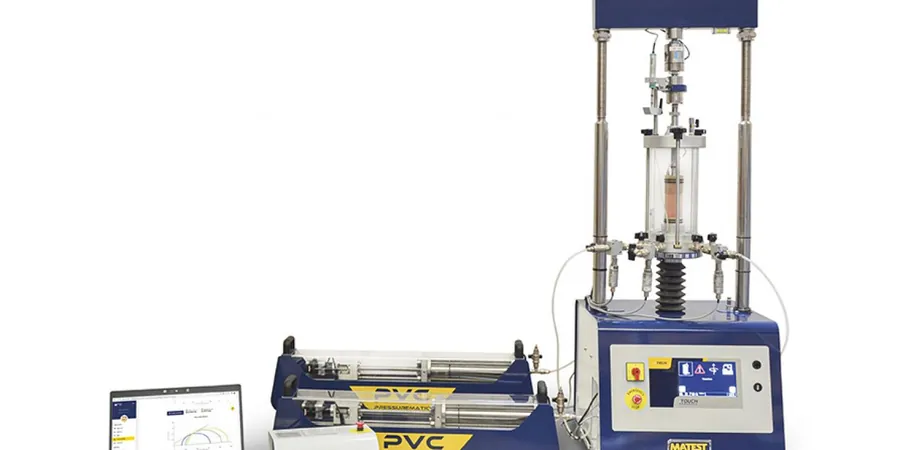
A direct shear test measures shear strength along a predetermined horizontal failure plane under drained conditions, making it suitable for assessing interface friction or evaluating coarse-grained soils where drainage is rapid. It is simpler and faster but does not control pore pressure. A triaxial test offers greater versatility, allowing for consolidated-drained, consolidated-undrained, or unconsolidated-undrained conditions, and measures strength along the plane of maximum shear. Triaxial tests are preferred when accurate effective stress parameters or undrained shear strength for cohesive soils are required.
Turnaround time varies significantly based on the test types and soil conditions. Basic index testing can often be completed within three to five business days. Consolidation tests typically require one to two weeks due to incremental loading and time-deformation readings. Triaxial shear tests with pore pressure measurement may need two to three weeks including saturation and consolidation stages. Rush services are sometimes available, but accurate results from long-duration tests like consolidation or permeability should not be compromised by accelerated schedules that deviate from ASTM standards.